StrikeWatch EA
Research Lab:
Options Analytics Guides for MetaTrader 5 Traders

Institutional options analytics — explained from first principles.
Understand the mechanics behind GEX, Max Pain, Volatility, and Smart Money flows.

Options Analytics Guides: GEX, Max Pain, Volatility & Smart Money for MT5

48 articles
Options Trade Management: Adjustments, Rolling, Partial Exits and Exit Rules

Options Trade Management: Adjustments, Rolling, Partial Exits and Exit Rules

Opening a trade is the easy part. The real skill in options trading is what you do after entry — when to hold, when to adjust, when to roll, and when to close. Most blown accounts are not the result of a bad entry. They are the result of a position that was left unmanaged until it was too late.

TSLA Post-Earnings Gamma Trap: The $300 Line and August Options Setup

TSLA Post-Earnings Gamma Trap: The $300 Line and August Options Setup

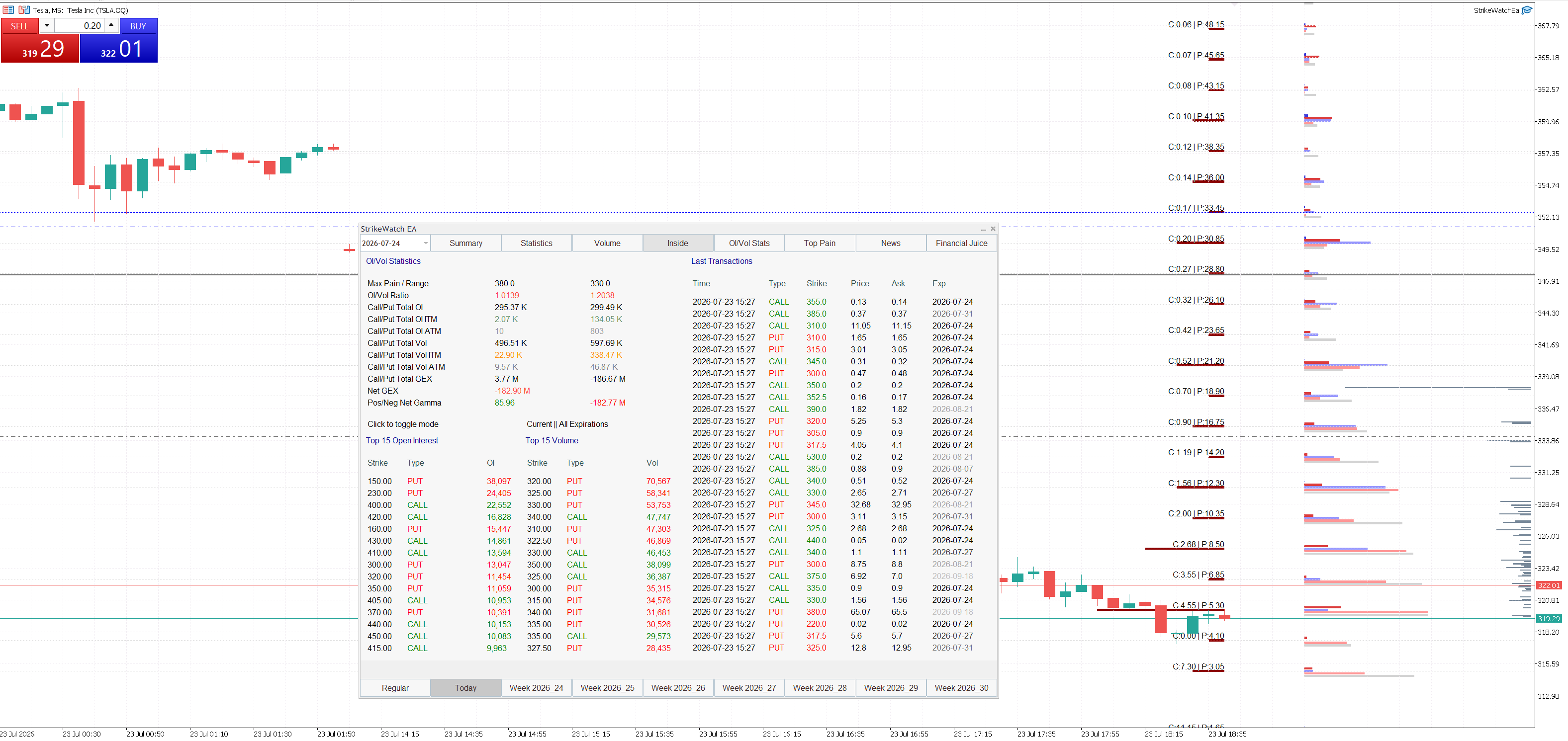
After spiking to $374 on Q2 earnings, Tesla sold off to $313 in two sessions. With Net GEX -$35.48M on the August OPEX, ZGL $357 as the regime-change threshold, and 101K ITM puts held by institutions — we break down four time segments and map concrete targets.

Kamil Dzyr — Chief Analyst, StrikeWatch EA
Trading Nasdaq 100 and Dow Jones CFDs with Options Chain Intelligence

Trading Nasdaq 100 and Dow Jones CFDs with Options Chain Intelligence

The options market is the single largest source of publicly available institutional intelligence — and most CFD traders ignore it entirely. The open interest structure of Nasdaq 100 and Dow Jones options tells you where market makers are hedged, where they will defend price mechanically, and where gamma dynamics will amplify or dampen moves. This article shows exactly how to use that intelligence to trade US100 and US30 CFDs with structural precision.

Nasdaq-100 Investing Methodology - constituent weights, mega-caps, and options strike mapping
Complete Guide

Nasdaq-100 Investing Methodology - constituent weights, mega-caps, and options strike mapping

The Nasdaq-100 is not a democratic basket of one hundred equally important companies. It is a highly concentrated index in which a handful of mega-caps, and the options strike zones surrounding them, very often define the direction, speed, and range of the entire QQQ and NQ complex.

The Structural Asymmetry of the Nasdaq-100: Why Mega-Cap Tech Dictates Index Mechanics and Derivative Pricing

The Structural Asymmetry of the Nasdaq-100: Why Mega-Cap Tech Dictates Index Mechanics and Derivative Pricing

A quantitative breakdown of how market-cap concentration in the Nasdaq-100 subverts diversification mechanics and dictates derivative pricing: the index weighting math, idiosyncratic shock contagion pathways, mega-cap-driven GEX and ZGL dynamics, implications for 0DTE and Negative GEX regimes, theta engine portfolio architecture rules, index-level Max Pain convergence from constituent OI walls, and three non-negotiable operational disciplines for NDX derivative traders.

Gamma Squeeze Mechanics: How Dealer Flow Creates Forced-Buying Cascades

Gamma Squeeze Mechanics: How Dealer Flow Creates Forced-Buying Cascades

A gamma squeeze is not a random breakout — it is a mechanical consequence of dealer delta-hedging obligations scaling non-linearly as gamma accelerates. Learn to identify the four pre-squeeze signals, distinguish a genuine squeeze setup from noise, and position for the cascade before it starts rather than chasing it after.

When to Buy vs. Sell Options: IV Regime & Strategy Selection Framework

When to Buy vs. Sell Options: IV Regime & Strategy Selection Framework

Same direction does not mean the same trade. A long call and a short put both profit from a rising stock, but they have opposite Theta exposure, opposite Vega exposure, and fundamentally different optimal market conditions. The IV regime — not the directional view — is the primary filter that determines which instrument to use.

The Four Option Positions: P&L on Every Dollar Move and Greeks Explained

The Four Option Positions: P&L on Every Dollar Move and Greeks Explained

Before you click buy or sell on any option, you need to know exactly what happens to your money on every single dollar move of the underlying — in your favor and against you. This article walks through all four basic positions with concrete numbers, Greeks behavior, and the structural logic behind each trade.

Options Contract Specs: American vs. European Style and Cash vs. Physical Settlement

Options Contract Specs: American vs. European Style and Cash vs. Physical Settlement

Every options signal — GEX, Max Pain, pin risk, 0DTE gamma — plays out differently depending on whether the contract you trade is American or European style, cash or physically settled. SPX and SPY both track the S&P 500, but their contract mechanics are fundamentally different: one can be assigned before expiration, the other cannot. Understanding these specifications is not administrative housekeeping — it determines your margin requirements, your assignment exposure, and whether a Max Pain pin translates into a cash credit or an unwanted 10,000-share position.

Fullscreen view