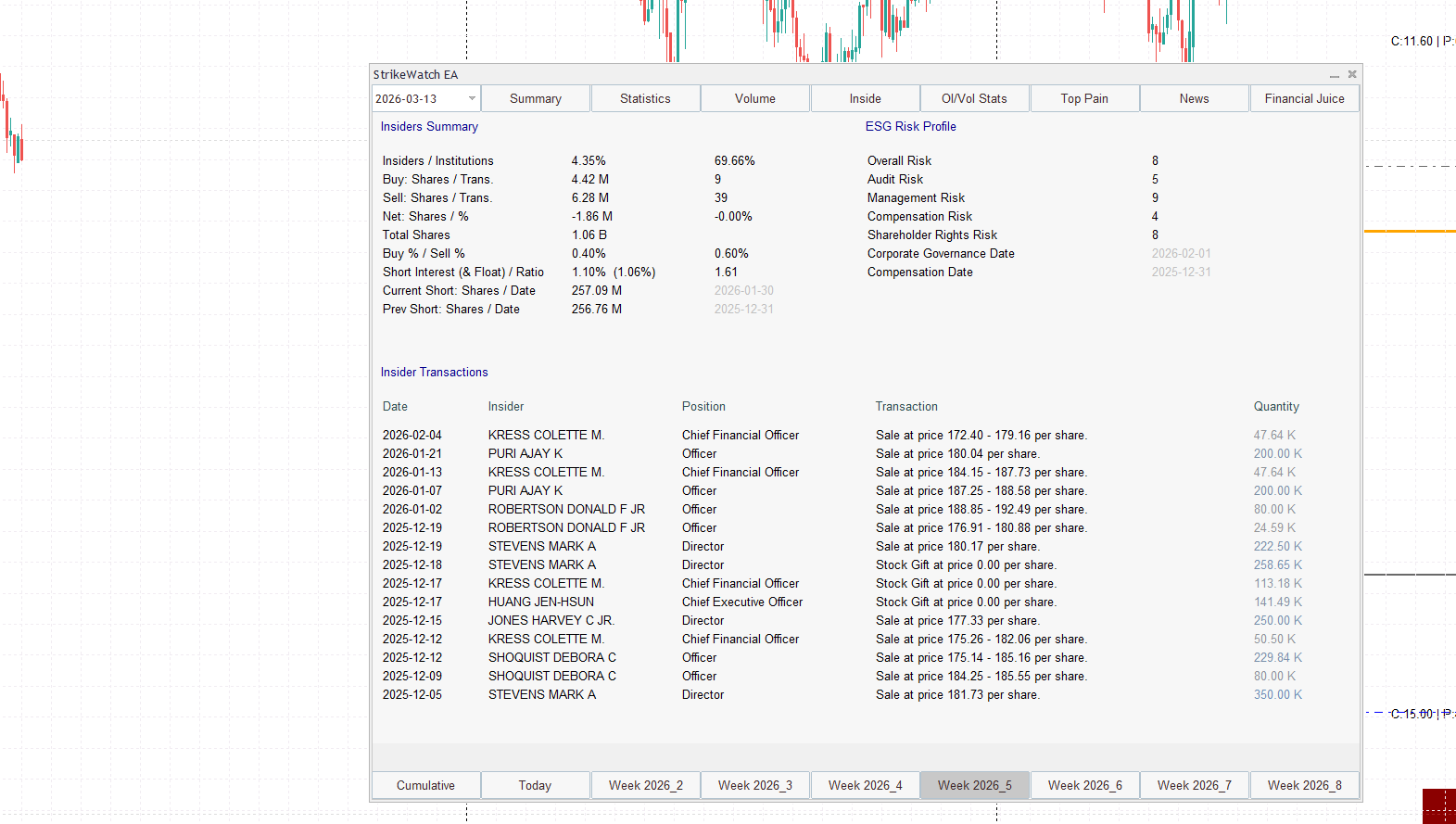
Why Insider Transactions Matter
Corporate insiders — CEOs, CFOs, directors, and beneficial owners of more than 10% of outstanding shares — are required by the SEC to disclose any transaction in their company's stock via Form 4, filed within two business days of execution. This regulatory requirement creates an extraordinary data stream: a near-real-time feed of the buying and selling decisions of the people who understand the company's fundamentals better than any external analyst.
The academic evidence is unambiguous. Lakonishok and Lee (2001) analyzed over 40 years of insider trading data and found that insider purchases consistently predict positive abnormal returns, with the signal strongest in smaller firms. Jeng, Metrick, and Zeckhauser (2003) estimated that insider purchase portfolios generate excess returns of approximately 50 basis points per month (6% annualized) after controlling for standard risk factors. More recent work by Zhao (2025) using gradient boosting on SEC Form 4 filings in microcap equities confirmed that machine learning classifiers can extract actionable signals from filing data, outperforming linear benchmarks in predicting 30-day abnormal returns.
The asymmetry between buys and sells is critical. Insider sales are noisy — executives sell for diversification, tax planning, or estate purposes. Insider purchases, however, require spending personal capital with no hedging motive. When the CFO writes a personal check for $500,000 in stock, that is a pure conviction signal.
Cluster Buying: The Strongest Signal
A single insider purchase is informative. Multiple insiders purchasing within a short window is far more powerful. This pattern — called cluster buying — suggests that the positive information is not limited to one individual's perspective but is shared across the management team.
Research by Seyhun (1998) demonstrated that cluster buying events — defined as three or more insiders purchasing within a 21-trading-day window — predict subsequent 6-month returns of approximately 8–12% above the market. The signal is strongest when:
- C-suite officers participate: Purchases by the CEO, CFO, or COO carry more predictive weight than purchases by outside directors, because operating executives have deeper visibility into upcoming earnings, pipeline developments, and strategic decisions.
- Purchase sizes are material: A $10,000 purchase by a billionaire CEO is negligible. A $500,000 purchase by a CFO earning $1.2M per year represents genuine skin in the game. The ratio of purchase value to annual compensation is a key filter.
- Timing follows weakness: Insiders buying after a 20–30% drawdown signals informed contrarian conviction. The insider believes the stock is mispriced relative to their private information.
StrikeWatch EA's Insider Intelligence module displays the last 15 Form 4 filings directly on your MT5 chart, with clear Buy vs. Sell classification. The Net Shares metric aggregates buying pressure against selling pressure, giving you a single directional bias derived from the people who know the company best.
The "Not-Sold" Signal: Information in Inaction
A groundbreaking study by DeVault, Cederburg, and Wang (2022) published in the Financial Analysts Journal introduced a counterintuitive finding: when a corporate insider sells stock at one company but does not sell their holdings at another company where they are also an insider, the not-sold stock outperforms significantly.
The logic is elegant. Portfolio insiders — individuals who serve as directors or officers at multiple public companies — reveal information about all their holdings when they trade at any one of them. If an insider sells Company A stock for liquidity but retains Company B stock, they are implicitly signaling higher conviction in Company B. The study found that a strategy buying "not-sold" stocks following insider sales earns Carhart four-factor alpha of 37 basis points per month (4.5% annualized, significant at the 1% level).
While StrikeWatch EA does not directly track cross-company insider portfolios, the Institutional Ownership panel provides the foundation for this analysis by comparing insider holdings percentages against institutional ownership — letting you gauge whether the stock's shareholder base reflects insider conviction ("diamond hands") or speculative momentum.
Short Interest Dynamics and Squeeze Mechanics
Short interest — the total number of shares sold short and not yet covered — provides a window into the bearish side of the market's conviction. Unlike insider data, which captures individual decisions, short interest aggregates the collective pessimism of hedge funds, algorithmic desks, and speculative shorts.
Key Metrics
- Short Ratio (Days to Cover): Short interest divided by average daily volume. It estimates how many trading days all shorts would need to exit their positions. A ratio above 5–7 days is the academic threshold for "crowded short" territory — meaning any positive catalyst can trigger a reflexive short-covering cascade.
- Short Interest Change (MoM): The month-over-month change in short interest. A rapidly increasing short interest suggests aggressive new bearish bets. A declining short interest into a price rally confirms that shorts are capitulating — fuel for further upside.
- Short Interest vs. Float: Short interest as a percentage of free float. When short interest exceeds 20% of float, the stock enters structural squeeze territory — there are literally not enough freely tradable shares to absorb cover orders without significant price impact.
The Anatomy of a Short Squeeze
Short squeezes are not random. They follow a predictable structural pattern:
- Crowding: Short interest builds over weeks/months. Days to Cover rises above 5. The short thesis is consensus, and the trade is crowded.
- Catalyst: An earnings beat, insider cluster buy, FDA approval, or simply a technical breakout above a key resistance level forces the weakest shorts to begin covering.
- Reflexive loop: Cover buying pushes price higher, triggering stop-losses on more short positions, generating additional forced buying. The feedback loop accelerates as dealers in negative gamma are forced to buy into strength, amplifying the move further.
- Exhaustion: Short interest collapses to normal levels. The squeeze is over. Price typically retraces 40–60% of the squeeze move as the artificial buying demand evaporates.
StrikeWatch EA's Short Squeeze Detector monitors all these metrics in real time: Short Ratio, Short Interest change vs. prior month, and short volume analytics. Combined with the OI/Volume Statistics module — which flags negative gamma positioning and speculative ATM call buying — you can identify the convergence of short-squeeze setup and options-driven acceleration before the move begins.
Governance Risk: The Hidden Tail Risk Filter
Not all insider signals are created equal. A cluster buy at a well-governed company is far more reliable than the same pattern at a company with red flags in its governance structure. Academic research by Bebchuk, Cohen, and Ferrell (2009) established the Entrenchment Index (E-Index), showing that poor governance provisions are associated with reduced firm value, lower profitability, and higher agency costs.
StrikeWatch EA's Governance & ESG Risk panel surfaces critical red flags:
- Audit Risk: Flags companies with a history of restatements, auditor changes, or material weaknesses in internal controls. High audit risk increases the probability that reported earnings — the foundation of every fundamental analysis — are unreliable.
- Management Compensation Risk: Identifies companies where executive pay is disconnected from performance. Excessive stock option grants incentivize short-term earnings manipulation, which inflates insider selling signals and makes genuine conviction purchases harder to identify.
Filtering governance risk before acting on insider signals dramatically improves signal quality. An insider buy at a company with low governance risk is a high-conviction structural signal. The same buy at a company with elevated audit risk may simply reflect executives supporting a stock price that their compensation packages depend on.
Combining Insider Flow with Options Intelligence
The most powerful setups occur when insider buying converges with options market signals:
- Insider buying + Positive GEX expansion: Management is buying while dealers are accumulating positive gamma. This means both informed insiders and the options microstructure are aligned bullish. Price is likely to be supported (dampened dips, accelerated rallies).
- Insider buying + Short squeeze setup: Management conviction overlapping with crowded shorts is the highest-alpha configuration. The insider buy can itself be the catalyst that initiates the squeeze.
- Insider buying + IV term structure backwardation: The options market is pricing near-term uncertainty (e.g., earnings) while insiders are buying. This asymmetry suggests insiders know the resolution will be positive — a high-edge long-gamma trade into the event.
These convergence setups identify when insider signals are actionable. For a complete decision framework on when these signals should override an attractive IV or GEX setup — and when a structurally weak equity backdrop should veto an otherwise seductive options structure — see Fundamentals, Insiders and ESG in Options Decisions →.
Insider Intelligence Inside StrikeWatch EA
StrikeWatch EA consolidates the full Smart Money analysis workflow inside MetaTrader 5:
- C-Suite Transaction Feed: The last 15 SEC Form 4 filings with Buy/Sell flags, insider role identification (CEO, CFO, Director), and transaction value. Spot cluster buying at a glance.
- Short Squeeze Analytics: Short Ratio (Days to Cover), Short Interest change vs. prior month, and Short Volume data. Identify crowded shorts before the squeeze materializes.
- Institutional vs. Insider Ownership: Side-by-side comparison of insider holdings and institutional holdings to gauge shareholder base quality and conviction alignment.
- Governance & ESG Risk Panel: Audit Risk and Management Compensation Risk scores to filter out stocks with structural governance deficiencies before acting on insider signals.
- Net Flow Sentiment: A synthesized directional bias metric that aggregates buying vs. selling pressure from insiders, giving you a single number to assess where the "smart money" stands.
Insider purchases are pure conviction signals. Unlike sales — which are noisy and driven by
diversification or tax needs — purchases require spending personal capital with no hedging motive. A CFO
writing a personal check is one of the most reliable public signals available to any trader.
Cluster buying is the strongest variant. Three or more insiders purchasing within a
21-trading-day window predicts 6-month excess returns of 8–12% (Seyhun 1998). Weight C-suite officers over
directors; weight material purchase sizes over token buys; weight buying after drawdowns over buying at
highs.
Inaction is also a signal. The "not-sold" effect (DeVault 2022) shows that when a
portfolio insider sells one holding but retains another, the retained stock earns 37 basis points per month
of excess alpha. Silence in the face of selling elsewhere is informative.
Short Interest above 20% of float creates squeeze territory. Days to Cover above 5–7 means
a single catalyst can trigger a reflexive covering cascade amplified by negative gamma dealer hedging.
Distinguish between legitimately impaired names (high SI + weak fundamentals) and overhyped story stocks
(high SI + strong catalysts incoming).
Filter all insider signals through governance quality. A cluster buy at a company with
elevated Audit Risk or excessive Management Compensation Risk may simply reflect insiders supporting a
stock price their option packages depend on — not genuine conviction about business value.
The highest-alpha setups are convergence setups. Insider buying aligned with positive GEX
expansion, a crowded short structure, or IV backwardation before earnings combines three independent
bullish forces. Each layer that confirms the thesis increases the probability of a successful trade.