The Limits of Chain-Only Thinking
Many options traders focus almost exclusively on the chain: implied volatility, skew, GEX, OI clusters, technical levels. This makes sense for short-term trades and index products, but for single stocks it can be dangerously incomplete. The equity is not a random ticker; it is a claim on a business.
Weak balance sheets, chronic cash burn, governance issues, elevated ESG risk and abnormal insider behavior all change the distribution of outcomes the options market is trying to price. Ignoring these while selling vol or leveraging up with long calls is like ignoring the foundation while admiring the paint on a house.
Core Fundamental Signals for Options Traders
You do not need to become a full-time equity analyst, but a handful of fundamental dimensions are critical:
- Balance sheet strength: Debt levels, interest coverage, and near-term maturities. Highly levered firms with tight liquidity have binary risk (refinance vs. distress).
- Cash flow and profitability: Persistent negative free cash flow, shrinking margins or serial equity issuance increase dilution and crash risk.
- Earnings quality and guidance: Aggressive accounting, repeated guidance cuts or restatements often precede volatility spikes.
Empirical work shows that firms with weaker governance and ESG scores, and those facing heightened litigation or regulatory risk, often experience fatter left tails and higher volatility. That matters directly for anyone short volatility or long leverage.
Insider Buying, Selling and Silence
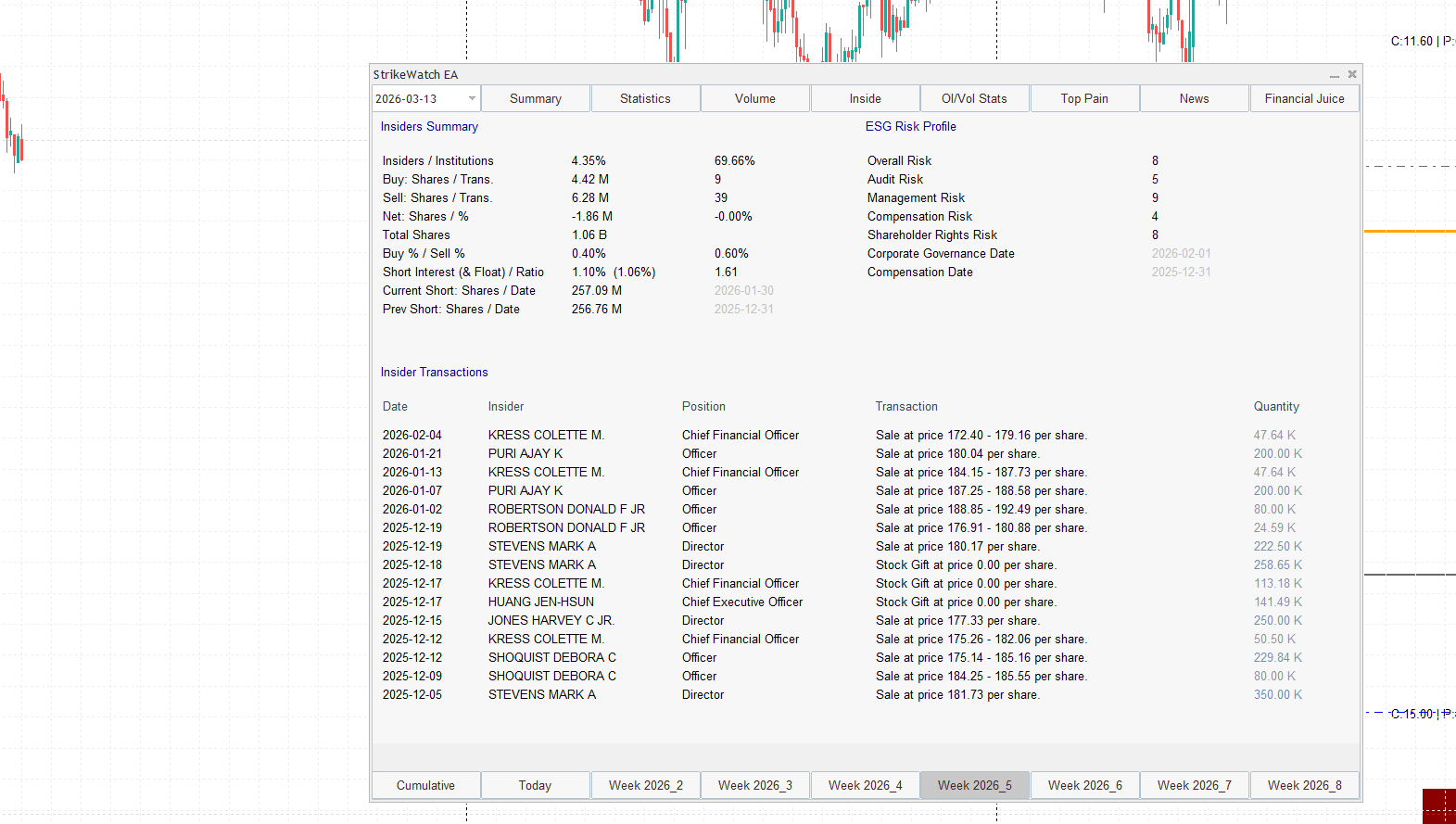
Insider transactions (C‑suite and directors) provide another window into the equity backdrop. Research finds that abnormal patterns — heavy selling before ESG incidents, or telling silence — can precede major negative events.
- Clustered insider buying near lows signals management conviction and can justify more constructive options structures (e.g. LEAPS, covered calls) despite elevated IV.
- Persistent insider selling into strength, beyond routine diversification, is a warning sign of overvaluation or upcoming negative news.
- Insider silence before ESG incidents: Insiders may deliberately avoid trading to reduce litigation risk ahead of major ESG events — patterns of inaction are informative too.
For options traders, insider behavior should not be treated as gospel, but as a weighting factor on whether to size up, size down, or avoid certain names for aggressive structures. For the complete mechanics — Form 4 filing windows, cluster buying thresholds, the not-sold signal, and governance red flags that filter signal quality — see the Insider Flow Tracking → guide.
Short Interest and the Risk of Squeezes and Crashes
Short interest — the percentage of float sold short — captures the market's aggregate bearish positioning and creates two competing risks simultaneously: high SI can signal structural problems that sophisticated investors have identified, while also creating squeeze potential if a positive catalyst forces covering. For Short Ratio, Days to Cover thresholds, and the four-stage squeeze anatomy, see the Insider Flow Tracking → guide.
The options implications are direct:
- Running large short‑call or call‑spread positions on high short‑interest names into catalysts is dangerous — squeezes can be brutal.
- Running aggressive short‑put structures on high short‑interest names with weak balance sheets is also dangerous — the crowd may be right about looming distress.
StrikeWatch's Fundamentals/Insiders module highlights short interest alongside fundamentals, helping you distinguish between overhyped, short‑squeezable names and legitimately impaired ones.
ESG Risk: When Non-Financials Become Financial
ESG (Environmental, Social, Governance) factors increasingly affect valuations and volatility through regulation, litigation and reputational risk. Examples:
- Environmental incidents (spills, emissions scandals) triggering fines and sudden repricing.
- Social and governance failures (labor abuses, fraud, corruption) leading to investigations and rapid loss of investor trust.
- Regulatory changes forcing capex, write‑downs or business model shifts.
Academic work suggests that ESG incidents are often preceded by patterns in insider behavior and governance metrics — including insider silence as events approach. For options traders, poor ESG scores and rising controversy indicators mean:
- A fatter left tail than historical volatility alone might imply.
- Less tolerance for large short‑vol or leveraged long exposures, regardless of what the chain says.
The governance mechanics that filter insider signal quality — Audit Risk and Management Compensation Risk scores — are detailed in the Insider Flow Tracking → guide.
When Fundamentals Should Override an Attractive Structure
Consider a stock where:
- IV is high, IV > HV, and GEX suggests supportive dealer hedging.
- The options chain makes a short‑put or iron condor look very attractive.
But Fundamentals/Insiders/ESG show:
- Negative free cash flow, high leverage and looming debt maturities.
- Spiking short interest and persistent insider selling.
- Ongoing ESG investigations and regulatory overhang.
In this case, the equity backdrop overrides the chain. The distribution of outcomes is no longer symmetric around "business as usual"; a crash or severe dilution scenario carries more weight than historical volatility would suggest. A disciplined StrikeWatch user should:
- Either avoid large short‑premium exposures outright, or
- Substantially reduce size, shorten duration and prefer defined‑risk structures.
When Fundamentals Support Aggressive Options Structures
Conversely, consider a high‑quality blue chip or ETF where:
- Balance sheet is strong; cash flows are stable; governance and ESG scores are solid.
- Short interest is moderate; insiders occasionally buy on dips.
- IV is elevated due to macro noise, but business risk is unchanged.
Here, the equity backdrop can support more aggressive volatility harvesting:
- Systematic short‑vol strategies (covered calls, cash‑secured puts, spreads) make more sense — see the Wheel Strategy → guide for a full income framework built on this premise.
- LEAPS or long‑dated call spreads can be structured as stock substitutes for long‑term theses.
The key is that the business is robust; you are selling volatility on a relatively solid foundation, not on quicksand.
Practical StrikeWatch Workflow: Fundamentals First, Chain Second
A practical process for integrating these modules:
- Screen: Use Summary to identify names with attractive IV/VRP and supportive GEX / Max Pain setups.
- Check equity backdrop: Open Fundamentals and Insiders/ESG:
- Leverage and interest coverage.
- Cash flow trends and profitability.
- Short interest, insider activity and ESG risk indicators.
- Classify: Place each candidate into "robust", "watchlist" or "avoid" buckets based on equity risk, not just chain appeal.
- Adjust structure: For robust names, you can run your full menu of strategies; for fragile names, restrict to hedged or limited‑risk structures, smaller size or shorter horizons.
This prevents the seductive combination of rich IV and neat GEX patterns from luring you into selling vol on ticking time bombs.
Case Archetypes: What to Do and What to Avoid
A few archetypal scenarios:
- Overlevered cyclical with rising rates: Attractive IV and OI structures, but debt covenants are tight; avoid large short‑put positions and prefer bearish or hedged structures.
- High‑short‑interest "story stock": Rich call IV and negative GEX above; avoid naked short calls; if trading, prefer defined‑risk call spreads or hedge with tail protection.
- Stable dividend payer with strong ESG profile: Moderate IV, good fundamentals; covered calls and Wheel‑style income strategies align well.
In each, the same IV chart can lead to opposite decisions once fundamentals, insiders and ESG are considered.
Letting the Business Speak in StrikeWatch EA
StrikeWatch EA's edge is not just in visualizing the options surface, but in connecting it to the underlying business. When you consistently:
- Scan IV/GEX and structure for opportunities.
- Cross‑check Fundamentals and Insiders/ESG for hidden tail risks.
- Allow equity reality to veto options structures when necessary.
you shift from trading isolated chains to trading business-backed options. Over the long run, this distinction often marks the difference between an options strategy that survives cycles and one that dies in the first real stress event.