What Is the Wheel Strategy?
The Wheel Strategy (also called the “Triple Income Strategy”) is a three-phase options income cycle that combines selling cash-secured puts and covered calls into a repeating loop. At every phase, you collect premium — generating income regardless of whether the stock goes up, down, or sideways.
- Phase 1: Sell a cash-secured put. You collect premium by agreeing to buy 100 shares at the strike price if the stock drops below it. If the stock stays above the strike, the put expires worthless — you keep the premium and repeat.
- Phase 2: Get assigned. If the stock drops below your put strike, you are obligated to buy 100 shares. Your cost basis is reduced by all premium collected to date. This is not a failure — you wanted to own this stock at this price.
- Phase 3: Sell a covered call. Now that you own 100 shares, sell a call against them. You collect premium while waiting for the stock to rise. If the stock rises above your call strike, shares are called away at a profit. The cycle restarts at Phase 1.
Sell Cash-Secured Put → Get Assigned Shares → Sell Covered Call → Shares Called Away → Repeat
The Wheel works because it harvests two structural edges simultaneously: theta decay (time value eroding every calendar day regardless of stock movement) and the Volatility Risk Premium (implied volatility’s persistent tendency to overstate subsequent realized volatility, making option sellers structurally overpaid for the risk they accept). For the full empirical basis of the VRP and how to measure it, see Variance Risk Premium.
Phase 1: Selling Cash-Secured Puts
A cash-secured put (CSP) is selling a put option while holding enough cash to buy 100 shares at the strike price if assigned. “Cash-secured” means no margin is used — the full purchase obligation is covered by cash in the account. For the foundational mechanics of the short put position (P&L graph, break-even calculation, and comparison to other short structures), see Four Option Positions §3.
Example: AAPL is trading at $185. You sell a $180 put expiring in 30 days for $2.50 ($250 per contract). You must have $18,000 in cash (100 shares × $180 strike) reserved. Two outcomes:
- AAPL stays above $180: The put expires worthless. You keep the $250 premium. Return: $250 / $18,000 = 1.4% in 30 days = ~16.7% annualized. Repeat.
- AAPL drops below $180: You are assigned 100 shares at $180. Your effective cost basis: $180 − $2.50 premium = $177.50. You now own AAPL at a 4% discount to where it traded when you entered. Proceed to Phase 3.
CSP Strike Selection by Delta
| Delta | Approx. OTM % | Assignment Probability | Premium Level | Best For |
|---|---|---|---|---|
| 0.30 delta | ~5–8% below stock | ~30% | Higher | Aggressive income; willing to be assigned frequently |
| 0.20–0.25 delta | ~8–12% below stock | ~20–25% | Moderate | Balanced; sweet spot for most Wheel traders |
| 0.10–0.15 delta | ~12–18% below stock | ~10–15% | Lower | Conservative; rarely assigned but lower income |
Professional recommendation: Use the 0.20–0.30 delta range with 30–45 DTE. This balances premium income against assignment probability. Shorter DTE options (weeklies) produce higher annualized returns but require more active management and result in more frequent assignment.
Phase 2: Assignment and Cumulative Cost Basis
Assignment is when the put buyer exercises their right to sell you 100 shares at the strike price. For Wheel traders, assignment is not a problem — it is the plan. You selected a stock you want to own, at a price you chose, and you were paid premium to buy it at a discount.
Cost Basis = Put Strike Price − Total Premium Collected (all rounds)
If you sold multiple rounds of CSPs before being assigned, your cost basis includes all premium collected across every round — not just the final one. This cumulative reduction is the Wheel’s core mechanical advantage:
Example: You sold $180 puts on AAPL for 3 months, collecting $2.50, $2.30, and $2.80 (expiring worthless each time). The 4th round results in assignment at $2.40 premium. Total premium across all rounds: $10.00. Effective cost basis: $180 − $10.00 = $170.00 — an 8.1% discount to the original $185 stock price.
This cumulative mechanism is why long-running Wheel positions on quality underlyings become progressively more resilient: the break-even drops further below the current price with each expiration cycle. Even a significant post-assignment drawdown may not reach your true cost basis if you collected multiple rounds of premium before assignment.
Phase 3: Selling Covered Calls
Once you own 100 shares, you enter Phase 3: selling covered calls. A covered call sells a call option against shares you already own. If the stock rises above the call strike at expiration, your shares are “called away” (sold) at the strike price. For the foundational mechanics of the short call position (P&L profile, break-even, and interaction with stock ownership), see Four Option Positions §2.
Critical rule: Sell the covered call at or above your cost basis. This ensures that if shares are called away, you exit the position with a profit regardless of where the stock trades relative to your assignment price.
Example: Cost basis from Phase 2 = $170.00. AAPL currently at $175. You sell a $180 covered call expiring in 30 days for $2.00 ($200). Two outcomes:
- AAPL stays below $180: Call expires worthless. Keep $200 premium. Cost basis drops further to $168.00. Sell another covered call next month.
- AAPL rises above $180: Shares called away at $180. Total profit: ($180 − $170 cost basis) + $2.00 call premium = $12.00/share ($1,200 per contract). Cycle restarts at Phase 1.
Covered Call Strike Selection
| Approach | Strike Selection | Tradeoff |
|---|---|---|
| Conservative | Above cost basis; 0.20–0.30 delta | Lower premium but guaranteed profit if called away; maximum downside protection |
| Moderate | Above current price; 0.25–0.35 delta | Better premium; some upside capture; slight risk if stock drops sharply after entry |
| Aggressive | Near current price; 0.40–0.50 delta | Highest premium; called away most frequently; caps nearly all upside |
If the stock is significantly below your cost basis after assignment, sell covered calls at or above cost basis even if it requires a lower-delta, lower-premium strike. Patience is mandatory — being called away at a strike below cost basis locks in a loss and negates the entire premium-collection advantage of the Wheel.
Stock Selection: The Foundation of the Wheel
The Wheel is only as good as its underlying stock. The strategy requires you to remain comfortable holding 100 shares through extended drawdowns — sometimes 3–12 months in a down cycle. Choosing the wrong underlying converts a systematic income strategy into a capital-destruction machine.
| Criterion | Requirement | Why It Matters |
|---|---|---|
| Business quality | Profitable, growing revenue, strong balance sheet | You may hold this stock for months during a downturn. It must be a company you are genuinely willing to own long-term. |
| Price range | $30–$200 for most retail accounts | 100 shares at $50 = $5,000 cash requirement. Higher-priced stocks limit diversification across positions. |
| Options liquidity | Bid-ask spread < $0.10; OI > 1,000 per strike | Tight spreads preserve premium on entry and exit; high OI ensures efficient execution and roll flexibility. |
| Implied volatility | Moderate-to-elevated (IVR 30–70) | Higher IV = richer premium. IVR > 80 often signals an imminent binary catalyst where premium richness is fair compensation for real danger. |
| Dividend | Preferred but not required | Dividends collected during Phase 3 add a third income layer beyond put and call premium. |
| Catalyst calendar | No earnings, FDA decisions, or legal rulings within option life | Binary events can gap a stock 15–25% overnight, creating deep assignment losses that years of premium income cannot recover. |
Common Wheel Underlyings by Risk Tier
- Conservative (ETFs): SPY, QQQ, IWM, XLF, EEM — maximum diversification, lowest single-name risk, deepest liquidity, but lower premium per dollar deployed.
- Moderate (Blue-chip stocks): AAPL, MSFT, GOOGL, JPM, HD, PG, KO — strong businesses you would hold regardless of short-term price action; the core of most sustainable Wheel portfolios.
- Aggressive (Higher-IV names): AMD, SOFI, PLTR, COIN — materially richer premium but significantly higher risk of deep drawdown after assignment. Position size must be reduced proportionally.
If you would not be comfortable owning 100 shares of a stock for 6–12 months during a 30% drawdown, do not Wheel it. Premium income cannot compensate for a fundamentally deteriorating business. The Wheel works best on stocks where you have genuine long-term conviction.
IV Timing: When to Enter and When to Wait
Not every day is equally good for selling CSPs. The Wheel’s edge amplifies dramatically when implied volatility is elevated — you collect above-average premium for identical risk exposure. The systematic entry signal is the same triple-confirmation rule that governs all premium-selling structures:
IVR > 30 + IVP > 50 + IV exceeds HV by 5+ points
When all three are confirmed: premium is above its historical average (IVR), the reading is robust
to spike distortion (IVP), and options are demonstrably overpricing actual realized movement
(IV–HV spread). This is the Wheel’s structural sweet spot.
When IVR is below 20 or IVP is below 30, the risk-reward of selling a CSP does not justify the obligation. Wait for IV to expand, or allocate capital to different structures. The Wheel is not a “trade every week” strategy — it is a “trade when conditions are favorable” strategy. For the full IVR/IVP measurement framework — including how to identify spike-distortion divergence between the two metrics and which one to trust — see IVR vs. IVP: Screening Workflow and the foundational reference Implied vs. Historical Volatility §7.
Realistic Return Expectations
The Wheel is an income strategy, not a capital appreciation strategy. Misaligned expectations lead to reckless position sizing and abandonment of the system during inevitable flat periods.
| Scenario | Annualized Return | Assumptions |
|---|---|---|
| Conservative | 12–18% | ETFs (SPY/QQQ); 0.20 delta; 30–45 DTE; low-to-moderate IV (IVR 25–45) |
| Moderate | 18–30% | Quality stocks (AAPL/MSFT/AMD); 0.25–0.30 delta; 30 DTE; moderate IV (IVR 35–60) |
| Aggressive | 30–50%+ | Higher-IV names (SOFI/PLTR/COIN); 0.30+ delta; weekly options; elevated IV (IVR > 50). Significantly higher drawdown risk. |
Community benchmark: r/Optionswheel practitioners consistently report 12–24% annual returns on deployed capital with disciplined Wheel execution on quality underlyings. Sustained claims above 50% typically involve elevated concentration risk, survivorship bias in reporting, or exceptionally favorable IV regimes that do not persist.
A single stock declining 40–50% post-assignment can wipe out 12–18 months of premium income from that position. This is why stock selection (Section 5) and position sizing (Section 8) are as important as entry timing.
Risk Management for the Wheel
Risk 1: Stock Crashes After Assignment
You sell a $50 put on XYZ, get assigned, and the stock drops to $30. Your $2 premium reduces cost basis to $48, but you are sitting on an $18/share unrealized loss ($1,800 per contract). This is the Wheel’s primary risk.
- Mitigation: Only Wheel stocks you would buy-and-hold regardless of short-term price action. Never Wheel speculative or unprofitable companies. Diversify across 3–5 underlyings to reduce single-name concentration.
Risk 2: Opportunity Cost (Capped Upside)
You sell a covered call at $55 on a stock at $50. The stock rockets to $80. Your shares are called away at $55 — you captured $5 upside but missed $25. This is not a loss; it is the price you pay for consistent income.
- Mitigation: Accept capped upside as the strategy’s design. If you want full upside exposure on a position, hold stock without selling calls. The Wheel and capital appreciation are mutually exclusive goals on any given position.
Risk 3: Early Assignment on Ex-Dividend Date
If your covered call is ITM near the ex-dividend date, the call buyer may exercise early to capture the dividend. You lose the shares, the remaining time value, and potentially the dividend itself.
- Mitigation: Check the ex-dividend date before selling covered calls. If the dividend is significant and your call is ITM within one week of the ex-date, roll the call to a higher strike or later expiration before the ex-dividend date.
Position Sizing Rules
- Maximum 20–25% of account per Wheel position. On a $50,000 account, no single stock should require more than $10,000–$12,500 in cash securing.
- Minimum 3–5 different underlyings. Diversification across uncorrelated names prevents a single-stock crash from inflicting catastrophic account damage.
- Maintain 10–20% cash reserve. Never deploy 100% of capital into active Wheel positions. The reserve funds new opportunities during corrections and prevents forced liquidation during volatile periods.
Common Wheel Strategy Mistakes
- Wheeling meme stocks or unprofitable companies. High IV means rich premiums, but GME or AMC can drop 60–80% post-assignment. Premium collected across six months of CSPs cannot compensate for that capital loss. Wheel quality businesses only.
- Selling covered calls below cost basis. When assigned at $50 and the stock drops to $40, the temptation to sell $42 covered calls for “quick income” is strong. If the stock recovers and shares are called away at $42, you locked in a realized loss. Always sell at or above cost basis — even if it means smaller premium.
- Ignoring IV conditions at entry. Selling CSPs when IVR is below 20 means collecting minimum premium for the same assignment obligation. Wait for IVR > 30 and IVP > 50 before opening new positions.
- Wheeling through earnings announcements. Earnings are binary events that can gap a stock 10–20% overnight. A CSP open during earnings exposes you to deep assignment well below your intended cost basis. Close or roll all positions before the earnings announcement date.
- Not tracking cumulative cost basis accurately. After multiple rounds of CSPs and covered calls across different expirations, your true cost basis can be difficult to reconstruct. Track every premium collected and every assignment price. Most broker displays do not automatically apply cumulative premium adjustments to cost basis reporting.
- Using margin instead of cash-securing. Margin amplifies returns in favorable conditions but triggers forced liquidation during corrections. A single 20% drawdown across margin-leveraged Wheel positions can trigger margin calls at the worst possible moment. Keep all positions fully cash-secured.
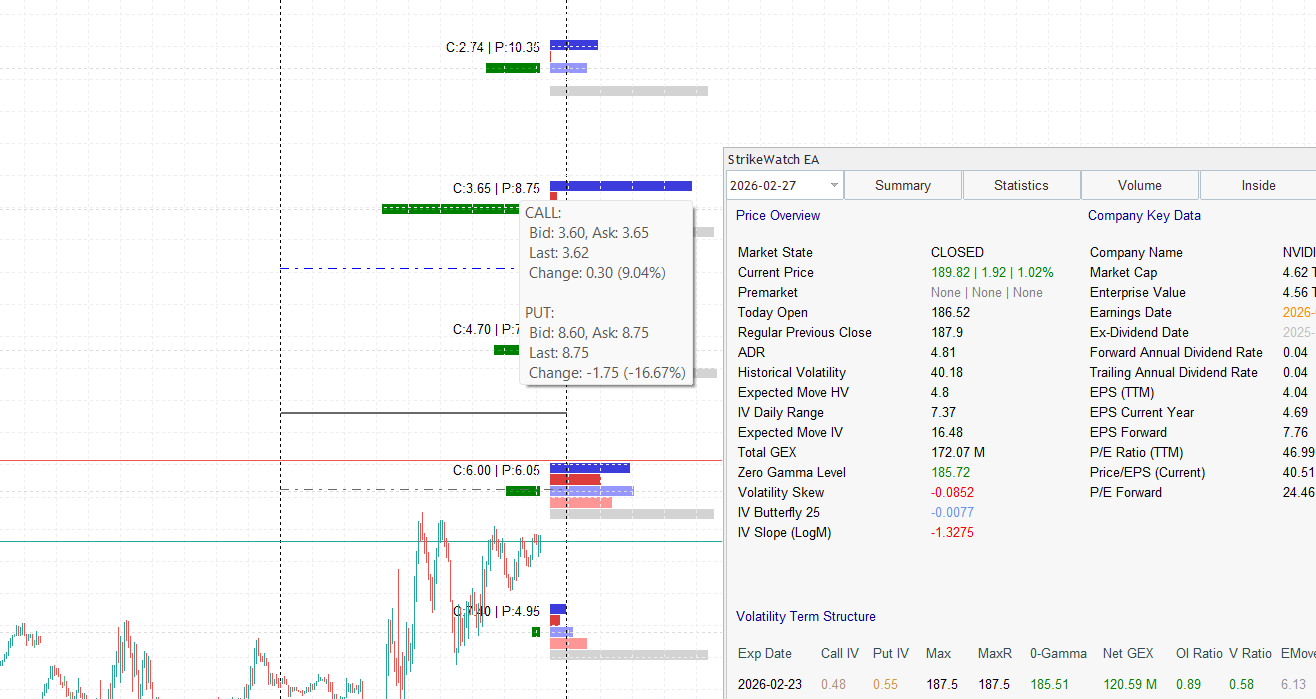
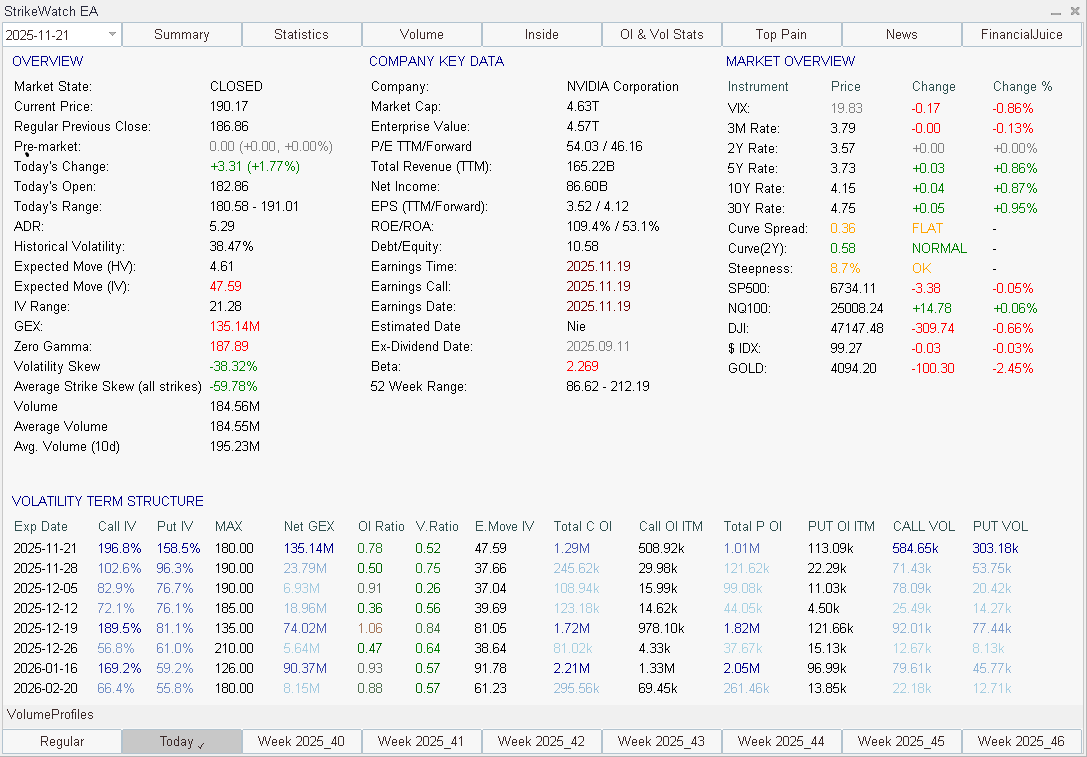
The Wheel in StrikeWatch EA
StrikeWatch EA provides the structural context that elevates Wheel execution from intuition-based to data-driven, covering every phase of the cycle:
- Summary Surface — IV Timing: Displays IV Rank, IV Percentile, and the live IV–HV spread simultaneously for the triple-confirmation entry check at Phase 1. When IVR and IVP diverge (a common post-spike condition), the divergence is immediately visible, preventing entry at artificially low IVR readings. Full IVR/IVP workflow: IVR vs. IVP Screening Guide.
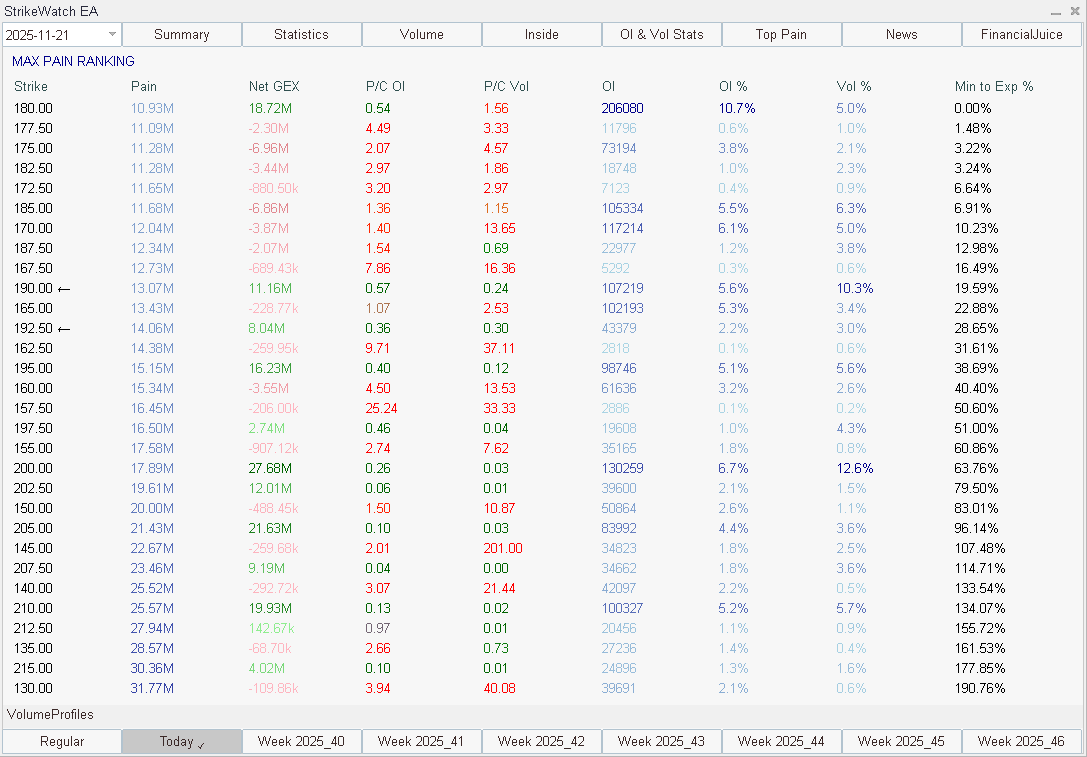
- Max Pain and Strike Wall Analysis — CSP Strike Placement: The Max Pain level shows where open interest is maximally concentrated — a structural gravitational target for price at expiration. Selling CSPs near or above the Max Pain strike adds the structural probability of price convergence to the statistical probability from delta. For identifying which strikes carry active dealer defense (positive GEX concentration, high OI walls) vs. statistically empty levels, see the full framework in Strike Wall Analysis.
- GEX Profile and ZGL — Regime Confirmation: Positive net GEX (spot above Zero Gamma Level) means dealer hedging will mechanically dampen intraday ranges — structural support for CSP strikes staying OTM. Before opening any new Wheel position, verify the GEX regime. Negative GEX increases the probability of gap moves that breach put strikes unexpectedly.
- OI / Volume Statistics — Institutional Support: Heavy put OI concentration at a strike below current price is a footprint of institutional hedging activity. Selling CSPs at or above high-OI put strikes means selling into established structural support — the market’s consensus floor for the near term.
- Expected Move — Probability Calibration: The 1-SD Expected Move boundary (Δ ≈ 0.16) represents approximately 84% probability of the stock staying within the range by expiration. Selling CSPs outside this boundary ensures a mathematically grounded probability estimate for OTM expiration, independent of subjective price targets.
To extend the Wheel from a single-ticker strategy to a full portfolio income engine — covering correlation management, expiration staggering, and portfolio-level sizing guardrails across multiple simultaneous Wheel positions — see Building an Options Income Portfolio.
The Wheel’s unique mechanical advantage is cumulative cost-basis
reduction. Every round of premium collected before assignment lowers your
break-even further below the strike price. A stock can decline significantly post-
assignment and still leave you profitable if you collected multiple rounds of premium
beforehand.
Stock selection is the Wheel’s most important variable.
Assignment is inevitable over time — the only question is whether you hold a
fundamentally strong business that recovers, or a deteriorating stock that keeps
falling. Never Wheel a stock you would not hold naked through a 30% drawdown.
IV timing directly multiplies income. Selling at IVR > 30 and
IVP > 50 vs. IVR < 20 can double the premium collected for identical strike
placement and expiration duration. The Wheel is not a set-and-forget weekly strategy
— favorable IV conditions are a non-negotiable entry filter.
Never sell covered calls below your cost basis. The patience
required to wait for the stock to recover above cost basis before selling calls is
exactly what separates consistently profitable Wheel traders from those who lock in
avoidable losses.
The covered call and CSP have identical P&L profiles (put-call
parity). Choose between them based on whether you already own shares —
not on any perceived risk difference between the two structures.