What Is Moneyness?
Moneyness describes the relationship between an option’s strike price and the current market price of the underlying asset. It answers one fundamental question: “If I exercised this option right now, would I make money?”
Based on the answer, every option falls into one of three states: In the Money (ITM), At the Money (ATM), or Out of the Money (OTM). Moneyness is not static — as the stock price moves, an option transitions freely between states. A call that was OTM this morning can become ITM by the afternoon if the stock rallies past the strike. This dynamic nature is what makes moneyness the most consequential decision in strike selection.
Moneyness determines: the option’s price composition (intrinsic vs. extrinsic value), its probability of profit at expiration, how sensitively it responds to stock moves, and which strategies it is suited for. No other single variable in options selection carries this much downstream consequence.
ITM, ATM, and OTM Defined
The definitions are reversed for calls and puts — this is the detail most beginners confuse. A call profits when the stock rises above the strike; a put profits when the stock falls below it:
| Moneyness | Call Option | Put Option | Intrinsic Value? |
|---|---|---|---|
| In the Money (ITM) | Stock Price > Strike Price | Stock Price < Strike Price | Yes — positive intrinsic value |
| At the Money (ATM) | Stock Price ≈ Strike Price | Stock Price ≈ Strike Price | Zero — maximum extrinsic value |
| Out of the Money (OTM) | Stock Price < Strike Price | Stock Price > Strike Price | Zero — all extrinsic (time) value |
Memory aid: For calls — “in the money = stock is above my buy price.” For puts — “in the money = stock is below my sell price.” The logic is always the same: ITM means you would profit from exercising right now.
Mirror Example: AAPL at $190
The following table shows how moneyness reverses symmetrically across calls and puts at the same strikes, using AAPL trading at $190 as the reference:
| Strike | Call Moneyness | Put Moneyness | Call Intrinsic | Put Intrinsic |
|---|---|---|---|---|
| $170 | Deep ITM (+$20) | Deep OTM ($0) | $20.00 | $0.00 |
| $185 | ITM (+$5) | OTM ($0) | $5.00 | $0.00 |
| $190 | ATM ($0) | ATM ($0) | $0.00 | $0.00 |
| $195 | OTM ($0) | ITM (+$5) | $0.00 | $5.00 |
| $210 | Deep OTM ($0) | Deep ITM (+$20) | $0.00 | $20.00 |
Notice the mirror pattern: at $170, the call is deep ITM while the put is deep OTM. At $210, it reverses completely. At $190 (ATM), both the call and put have zero intrinsic value. This inverse relationship is fundamental to every multi-leg strategy from spreads to strangles.
Intrinsic Value vs. Extrinsic Value
An option’s total premium is the sum of two components: intrinsic value (the real profit from immediate exercise) and extrinsic value (the time and volatility premium the market charges beyond intrinsic). Moneyness determines the ratio between these two components — and that ratio defines the option’s entire risk profile:
| Moneyness | Intrinsic Value | Extrinsic Value | Total Premium | Composition |
|---|---|---|---|---|
| Deep ITM | High | Low | Highest | ~90% intrinsic / ~10% extrinsic |
| ITM | Moderate | Moderate | High | ~60% intrinsic / ~40% extrinsic |
| ATM | Zero | Highest | Moderate | 0% intrinsic / 100% extrinsic |
| OTM | Zero | Moderate | Low | 0% intrinsic / 100% extrinsic |
| Deep OTM | Zero | Very low | Lowest | 0% intrinsic / 100% extrinsic |
The critical insight is that ATM options carry the highest extrinsic value of any moneyness level. ATM is the point of maximum uncertainty — the market does not know whether the option will end up ITM or OTM, so it assigns maximum time premium. This is why ATM options are the most sensitive to time decay and implied volatility changes, and why premium sellers who want to harvest extrinsic value typically target ATM or near-ATM strikes.
At expiration, extrinsic value goes to zero. Only intrinsic value survives. This means every OTM option at expiration is worth exactly $0 — a 100% loss of premium paid. Every ITM option at expiration is worth exactly its intrinsic value. The moneyness decision at entry determines which outcome is structurally possible.
How Greeks Behave Across Moneyness
Delta, Gamma, Theta, and Vega each reach their peak sensitivity at different moneyness levels — a pattern that governs how your option responds to every market change. The universal rule: ATM options are the most sensitive across all four Greeks. Delta peaks deep ITM (~1.0). Gamma, Theta, and Vega all peak ATM and collapse toward zero in both directions. Deep OTM options have very low sensitivity to all Greeks until they approach expiration or the stock moves aggressively toward the strike.
For the complete Greek mechanics — formulas, interactions, and how each Greek changes with time and volatility at each moneyness level — see the Options Greeks guide. Understanding moneyness and Greeks together is what allows you to predict precisely how a position will behave before you enter it.
Probability of Profit: The Core Tradeoff
Moneyness directly determines the probability that an option finishes profitable at expiration. Delta serves as a practical proxy for this probability — a 0.30 delta call has roughly a 30% chance of expiring in the money. This creates the fundamental tradeoff every options trader navigates:
| Moneyness | Approx. Delta (Call) | Probability ITM at Expiry | Cost | Leverage |
|---|---|---|---|---|
| Deep ITM | 0.85–1.00 | ~85–95% | Highest | Lowest |
| ITM | 0.60–0.80 | ~60–80% | High | Low-Moderate |
| ATM | ~0.50 | ~50% | Moderate | Moderate |
| OTM | 0.20–0.35 | ~20–35% | Low | High |
| Deep OTM | 0.05–0.15 | ~5–15% | Lowest | Highest (theoretical) |
For option buyers: you are paying for probability. ITM options are more expensive because they are more likely to finish profitable. OTM options are cheaper because they expire worthless most of the time. For option sellers: you collect premium from buyers who want probability. Selling a 0.25 delta put wins approximately 75% of the time — but each loss can exceed the premium collected if not properly defined by a spread structure.
The OTM Lottery Pitfall
The most common and most costly beginner mistake is buying deep OTM options because they appear cheap. A $0.10 option on AAPL costs only $10 per contract. The allure is clear: if AAPL makes a large move, the option could theoretically return 5,000%. Here is why this reasoning destroys accounts over time:
- You need a large move AND it must happen before expiration. Deep OTM options require the stock to move well past the strike — often 5–15% or more — within the remaining DTE window. Most options expire before this happens.
- Time decay accelerates against you. OTM options lose extrinsic value every day. Because they have no intrinsic value to fall back on, theta erosion consumes the entire premium. An option that does not move aggressively in your favor quickly becomes worthless through decay alone.
- Implied volatility works against buyers in normal conditions. The Volatility Risk Premium means options are structurally overpriced relative to subsequent realized volatility approximately 85% of the time. Deep OTM buyers are paying the highest proportional premium for this overstatement.
- The math is cumulative. Losing 100% on five OTM bets and winning 500% on one does not make you profitable — it leaves you even at best, before transaction costs. The realistic hit rate for deep OTM directional bets is low enough that systematic buyers reliably underperform.
Professional traders use deep OTM options as risk-limiter legs in multi-leg structures (iron condors, butterflies, spreads) — not as profit centers. The deep OTM leg caps maximum loss for a defined, acceptable cost. Buying a $0.10 option as a standalone directional bet is a lottery ticket. Buying the same option as the wing of an iron condor to cap your short put spread risk is disciplined risk management.
Strategy Selection by Moneyness
Each options strategy has an optimal moneyness range that aligns the probability, cost, and Greek profile with the strategy’s objective. Deviating from this range — buying too far OTM for a directional trade or selling too deep ITM for premium income — systematically degrades performance:
| Strategy | Recommended Moneyness | Target Delta Range | Rationale |
|---|---|---|---|
| Long call (bullish directional) | ATM to slightly ITM | 0.50–0.70 | Responsive to stock movement; reasonable cost; decent ITM probability without paying deep ITM premium |
| Long put (bearish or portfolio hedge) | ATM to slightly OTM | 0.30–0.50 | Cheaper than ITM puts for protection; covers moderate declines; manageable extrinsic cost |
| Covered call (income on long stock) | OTM | 0.20–0.35 | Allows stock appreciation up to strike; low assignment probability; premium income with upside participation |
| Cash-secured put (Wheel Strategy) | OTM | 0.20–0.30 | ~70–80% probability of expiring worthless; premium collected while waiting for assignment at a discount |
| Vertical spread (debit) | Buy ATM, sell OTM | Long 0.50 / Short 0.25–0.35 | ATM long leg captures movement; OTM short leg reduces cost; defined risk, defined reward |
| Iron condor (range-bound) | Sell OTM on both sides | 0.15–0.25 each side | Wide profit zone between strikes; high probability all legs expire OTM; harvest extrinsic value from both sides |
| Long straddle (volatility bet) | ATM (both call and put) | ~0.50 / ~−0.50 | Maximum Gamma and Vega; profits from large move in either direction; requires significant move to overcome theta decay |
Reading Moneyness on the Options Chain
On any options chain, moneyness is immediately visible from the structure of strikes around the current stock price. The ATM strike is the row closest to the current price — it is your reference point for all analysis. Moving up from ATM gives you OTM calls (higher strikes) and ITM puts (lower strikes). Moving down from ATM gives you ITM calls and OTM puts.
The fastest way to assess moneyness numerically on the chain is the Delta column: 0.50 delta = ATM, above 0.50 = ITM for calls, below 0.50 = OTM for calls. This is also where the relationship between moneyness and open interest becomes visible — OI and volume concentrate heavily at and near ATM strikes, which is why ATM levels carry the most structural significance for dealer hedging and Max Pain mechanics.
Moneyness in StrikeWatch EA
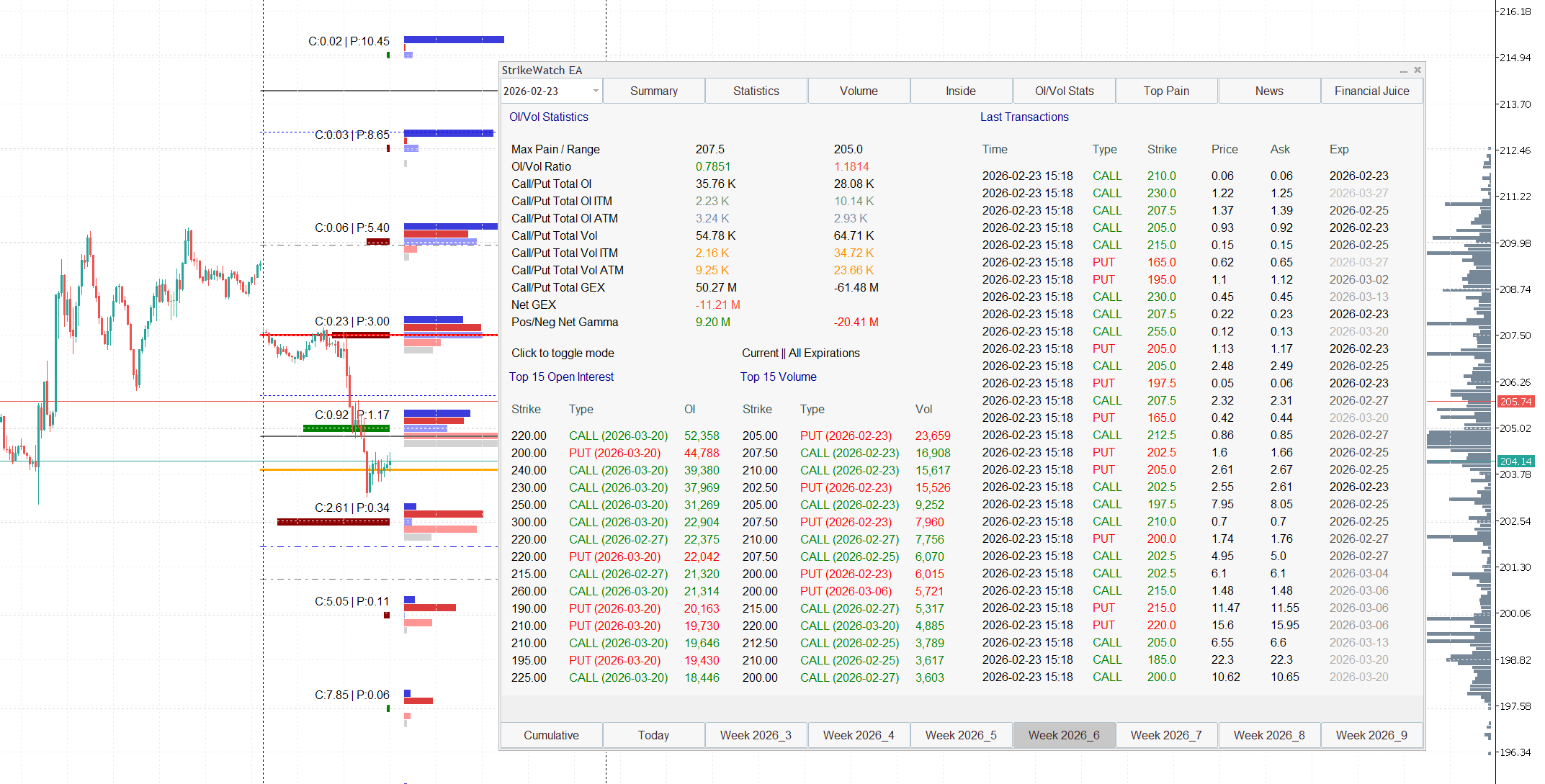
StrikeWatch EA provides multiple views that make moneyness analysis immediate inside MetaTrader 5:
- OI/Volume Statistics — ATM Concentration: The Top 15 Strikes module visualizes where open interest and volume are concentrated by moneyness level. ATM strikes always dominate — confirming they carry the highest structural significance for dealer hedging. The per-strike Put/Call Ratio shows whether the ATM concentration is call-heavy (bullish positioning) or put-heavy (hedging or bearish conviction).
- On-Chart HUD — Strike Context: The overlay marks the current ATM strike relative to the GEX profile and Max Pain level, giving you instant visual context for whether you are trading at, above, or below the structural gravity zone. The relationship between the current price and the ATM strike determines whether dealer hedging is currently stabilizing (positive GEX, near ATM) or amplifying (negative GEX, away from ATM concentration).
- Summary Surface — IV by Moneyness: The per-strike implied volatility display shows the volatility smile — how IV varies across ITM, ATM, and OTM strikes for each expiration. When OTM puts show significantly elevated IV relative to ATM, it confirms the structural put skew described in the Volatility Skew guide.
ITM options have intrinsic value; OTM options have none. At expiration,
every OTM option expires worthless. Every ITM option is worth exactly its intrinsic
value. Moneyness is the single most consequential input to what an option is worth at
expiry.
ATM options carry the highest extrinsic value. They are the most
sensitive to time decay (Theta) and volatility (Vega) — making them the preferred
strike for premium sellers harvesting the Volatility Risk Premium and for buyers who
want maximum delta-adjusted responsiveness.
Deep OTM options are not cheap — they are expensive relative to their
probability. The cost-to-probability ratio is worst at deep OTM strikes.
Use them as risk limiters in spreads, not as standalone directional bets.
Match moneyness to strategy objective. Directional buyers target ATM
to slightly ITM (0.50–0.70 delta). Premium sellers target moderately OTM
(0.20–0.30 delta). Volatility traders target ATM (0.50 delta) for maximum
Gamma and Vega exposure.
Delta is your moneyness gauge on the chain. 0.50 = ATM, above 0.50
= ITM for calls, below 0.50 = OTM for calls. The
Greeks guide
covers the full mechanics of how each Greek behaves across the moneyness spectrum.