The Three Information Layers of Options Flow
Every options market simultaneously broadcasts three distinct categories of information. Most retail traders access only one at a time — usually surface-level volume data. Institutional analysts read all three simultaneously, understanding how each layer modifies the interpretation of the others. The framework begins with a clear separation of what each layer measures and what question it answers:
| Layer | Primary Metric | Question It Answers | Time Horizon | Update Frequency |
|---|---|---|---|---|
| Layer 1 — Structure | Open Interest (OI) | Where has capital been committed, and how much? | Days to months (cumulative) | Once daily, after session close |
| Layer 2 — Activity | Volume + V/OI Ratio | Where is capital moving right now, and is it new or closing? | Intraday to days | Real-time (resets each morning) |
| Layer 3 — Aggression | Tape + Aggressor Side | How urgent is the positioning? Who is demanding liquidity? | Minutes to hours | Real-time (tick-by-tick) |
Layer 1 (Structure) is the geological record of the market — where large capital has been deployed over weeks and months, creating the support and resistance zones that dealer delta-hedging turns into mechanical price attractors. High OI creates gravity. Low OI creates vacuum. The complete mechanics of how OI builds, peaks, and decays across an expiration cycle are in the Open Interest vs. Volume guide.
Layer 2 (Activity) is today’s weather on top of that geological record. Volume tells you where capital is currently moving. The V/OI ratio tells you whether that movement is creating new exposure or unwinding existing positions — the critical distinction between conviction and liquidation. How to read every column of the chain that surfaces these signals is covered in the Options Chain Reading guide.
Layer 3 (Aggression) is the real-time pulse of informed participants. Consistent ask-side buying on large size reveals urgency — someone is willing to pay the liquidity premium to establish a position immediately rather than wait for a better fill. This is the behavioral signature of time-sensitive conviction. The complete framework for reading the tape, classifying institutional archetypes, and detecting rolls vs. fresh positioning is in the Options Order Flow & Market Maker Positioning guide.
No single layer is sufficient alone. High volume (Layer 2) without OI context (Layer 1) cannot distinguish new conviction from liquidation. High OI without aggressor-side data (Layer 3) cannot reveal direction. Tape aggression without structural context misses whether dealer hedging will reinforce or oppose the institutional bet. All three layers must align for a maximum-conviction signal.
The Four Flow Regime Archetypes
Combining all three information layers produces four distinct market regimes — each with a specific flow fingerprint, a specific structural implication, and a specific set of actions. Identifying the current regime before selecting any trade is the foundational step of flow intelligence:
| Archetype | OI Pattern | Volume Signal | Tape Aggression | Price Behavior | Actionability |
|---|---|---|---|---|---|
| 1. Accumulation | Rising over multiple sessions; gradual buildup at specific strike | Elevated but not explosive; V/OI 0.5–1.5 | Consistent ask-side on moderate size; no urgency spike | Stable or gradually trending; no breakout yet | High — institution is building position methodically; directional move likely ahead |
| 2. Speculative Burst | OI spikes overnight; V/OI > 2.0; single expiration concentration | Explosive; well above 5× average; compressed into 1–3 sessions | Heavy ask-side; golden sweep pattern; premium > $250K | Often triggers or immediately precedes sharp directional move | High — highest urgency signal; short time window to follow; apply all context filters immediately |
| 3. Structural Hedging | Gradual OI buildup in index products; puts on rising equity | Elevated but systematic; consistent across sessions | Mid-market or bid-side fills; no urgency | Underlying often rising or stable; hedge is protective, not predictive | Low — no directional alpha; signals macro uncertainty but not price direction |
| 4. Distribution | Falling OI despite high volume; existing positions closing | High absolute volume; V/OI > 1.0 but OI declining | Bid-side dominance on large prints; urgency to exit | Price often weakening or stalling despite volume | High (contrarian) — smart money exiting; existing trend may be exhausting; best used to time exits from long positions |
Archetypes 1 and 2 carry directional alpha for new entries — capital is being committed with conviction in a specific direction. Archetype 3 carries no directional alpha but signals the macro risk backdrop. Archetype 4 carries timing alpha for exits — it tells you when to close existing positions before smart money fully unwinds theirs.
The clearest market regimes are those where a single archetype dominates. The most treacherous are mixed regimes where Accumulation in individual names coexists with Structural Hedging in index products — institutions building individual stock longs while simultaneously hedging macro exposure. In mixed regimes, single-stock flow remains directionally actionable; index-level hedging flow provides context for the broader risk environment, not a trade signal.
GEX Confirmation Matrix
The GEX regime — whether the market is in positive or negative gamma — is the multiplier that determines how much follow-through any flow signal will produce. The same institutional print can be a high-probability setup in one regime and a low-probability trap in another. For the complete GEX mechanics, see the Dealer Hedging Regimes & GEX guide. Here, the focus is on how GEX regime interacts with each flow archetype:
| Flow Archetype | Positive GEX Regime | Negative GEX Regime | Interpretation |
|---|---|---|---|
| Accumulation (bullish) | Moderate follow-through; dealer hedging dampens momentum | Strong follow-through; dealer hedging amplifies momentum | Wait for price to break above ZGL before entering; momentum accelerates once regime flips |
| Speculative Burst (bullish) | Lower probability; dealers sell into rallies near OI walls | Higher probability; dealers buy into rallies, amplifying the squeeze | Apply tighter sizing in positive gamma; full conviction in negative gamma with context filters passed |
| Distribution | Slow, grinding price weakness; support floors absorb selling | Accelerated decline; no dealer stabilization below ZGL | Most dangerous in negative gamma; exit long positions immediately when distribution appears below ZGL |
| Structural Hedging | Put walls below create mechanical support; market stable | Put walls below create dealer selling on breakdowns; negative feedback | In negative gamma, heavy put OI below is not support — it becomes a gamma cliff that accelerates the move |
The most powerful trade setup in the entire flow intelligence framework is an Accumulation or Speculative Burst archetype in a negative GEX regime where price is approaching or has just broken through the ZGL from below. This combination aligns three forces simultaneously: institutional conviction (flow direction), mechanical amplification (negative gamma dealer hedging), and structural confirmation (ZGL breach). All three push in the same direction.
Conversely, the most dangerous false signal is a Speculative Burst in a deep positive GEX regime, with the underlying pressing against a major call OI wall. Institutional conviction may be real — but dealer hedging mechanics will mechanically suppress the move, grinding the position to expiration without the expected acceleration. Flow without regime context consistently produces these expensive surprises.
Flow Signal Decision Tree
When observing options activity on any underlying, this decision tree determines which analytical tool to apply, which archetype is operating, and whether a trade setup exists. Work top to bottom, branching at each decision point:
-
Check GEX regime first.
Is the underlying above or below the Zero Gamma Level?- Above ZGL (positive gamma) → follow-through is dampened. Require stronger flow convergence before acting. Ideal for premium-selling setups.
- Below ZGL (negative gamma) → follow-through is amplified. Lower convergence threshold required. Directional long/short setups have higher edge.
-
Identify the dominant flow type.
Is current activity predominantly ITM + systematic (Structural Hedging → no trade) or ATM/OTM + ask-side (Speculative / Accumulation → proceed)? Use the Hedging vs. Speculative classification framework. -
Confirm with V/OI ratio.
Pull the V/OI ratio at the high-activity strike using the chain V/OI table:- V/OI < 0.5 → normal churn. No signal.
- V/OI 0.5–1.5 → Accumulation archetype possible. Check OI direction over the next 2–3 sessions.
- V/OI > 2.0 → Speculative Burst or Distribution. Check tape aggressor side to distinguish.
-
Read tape aggressor side.
Consistent ask-side on large size → new conviction, proceed toward entry. Consistent bid-side on large size → Distribution archetype, evaluate exits, not entries. Mixed aggressor → position transfer or rotation, no directional signal. -
Apply the three context filters.
Run the signal through the UOA context filters: earnings proximity, OI buildup pattern, GEX regime confirmation. All three must pass for maximum-conviction entry. -
Classify the structural level.
Is the current price at, above, or approaching a significant OI wall identified in the Strike Wall Analysis framework? Flow aligned with structure (buying near put wall support, selling near call wall resistance) has the highest probability. Flow contrary to structure (buying into a call wall, selling through a put wall) signals a potential structural breakdown — higher risk but also higher reward. -
Size and execute.
Match position size to the regime: tighter in positive gamma (dampened moves), larger in negative gamma (amplified moves). Apply the 1–2% account rule, 50% stop, 100–200% target regardless of conviction level.
Pre-Trade Flow Checklist
Before executing any flow-based trade, verify all six conditions. This checklist compresses the full decision tree into a rapid pre-entry verification that takes under two minutes with StrikeWatch EA’s panels open:
| # | Question | Pass Condition | If Failed |
|---|---|---|---|
| 1 | What is the current GEX regime? | Negative gamma (below ZGL) preferred for directional trades. Positive gamma acceptable for premium selling. | Reduce size by 50% if entering directional in positive gamma. Never chase breakouts in positive gamma. |
| 2 | Is the dominant flow type speculative or hedging? | Speculative (ATM/OTM + ask-side + individual name). Hedging flow = no trade. | If hedging dominant, stand aside on directional trade. Use regime context for premium selling instead. |
| 3 | Does V/OI confirm new positioning? | V/OI > 1.0 with OI expected to rise tomorrow (not falling or flat). | High volume + falling OI = liquidation. Do not enter in direction of the flow. |
| 4 | Does tape aggression match the thesis? | Consistent ask-side prints for bullish thesis. Consistent bid-side prints for bearish. | Mixed aggressor side = rotation or roll. Remove from directional signal set. |
| 5 | Do all three context filters pass? | No earnings within 7 days. Gradual OI buildup pattern. GEX regime confirms follow-through. | Any single filter failure = reduce to observation only. All three failed = no trade. |
| 6 | Is the structural level consistent with the flow direction? | Flow direction aligns with nearest structural support (bullish) or resistance (bearish) from OI walls. | Flow against structure = possible structural breakdown. Use tighter stop, smaller size, wider target. |
A trade where all six conditions pass simultaneously is a maximum-conviction setup. In practice, four or five conditions passing with one minor exception may still be actionable — but size down proportionally. The purpose of the checklist is not to eliminate all trades that are not perfect; it is to ensure that the quality of each entry is consciously evaluated rather than driven by urgency or fear of missing the move.
Flow Intelligence by Moneyness Zone
The moneyness of the options where unusual activity concentrates provides a rapid first-pass classification of the flow regime. Each moneyness zone has a dominant institutional use case that constrains what the flow most likely means:
| Moneyness Zone | Dominant Flow Archetype | Primary Interpretation | Directional Content |
|---|---|---|---|
| Deep ITM (Δ > 0.80) | Structural Hedging / Synthetic | Stock replacement, delta management, synthetic structure construction | Low standalone; look for accompanying equity activity |
| ATM (Δ 0.40–0.60) | Accumulation or Speculative Burst | Highest information density zone. Precision directional bet or event-driven positioning | Highest — ATM flow with ask-side aggression is the strongest directional signal |
| OTM (Δ 0.15–0.35) | Speculative Burst (ask-side) or Structural Hedging (bid-side puts) | Ask-side calls = leveraged directional bet. Bid-side puts = portfolio protection program | High if ask-side; low if bid-side puts on index |
| Deep OTM (Δ < 0.15) | Tail hedge or noise | Spread risk-limiter, tail protection, or retail speculation. Rarely standalone institutional directional | Low — almost never actionable as standalone signal |
The moneyness filter is most useful as a first-pass triage: deep ITM and deep OTM flow automatically routes to lower-priority analysis unless accompanied by extraordinary size or the dark pool combo pattern. ATM and moderately OTM flow with ask-side aggression routes immediately to the full five-signal diagnostic and three-context-filter process.
Convergence: When All Layers Align
The concept of convergence — multiple independent signals pointing in the same direction simultaneously — is the operational core of flow intelligence. Each additional layer that confirms the thesis multiplies the probability of a successful trade. Conversely, divergence between layers is a warning signal that the thesis may be incomplete or incorrect.
Maximum Convergence Setup
The highest-probability setup in the framework occurs when the following align simultaneously:
- Layer 1 (Structure): OI building gradually at a specific ATM/OTM strike over 3+ sessions, with the nearby structural level (Max Pain or major put wall) supporting the direction.
- Layer 2 (Activity): V/OI ratio spikes above 2.0 with volume well above the 5× average threshold.
- Layer 3 (Aggression): Consistent ask-side prints; clustered golden sweeps; premium exceeds $500K total across the session.
- GEX Regime: Market is in negative gamma (below ZGL) or approaching the ZGL from below with the flow direction aligned with the expected ZGL breakout.
- Context Filters: No earnings within 7 days; gradual OI buildup confirmed; regime confirmation passed.
This setup is rare — perhaps 3–5 times per month on any single liquid underlying. It is worth waiting for. Chasing lower-convergence signals with equivalent position sizing is the primary source of poor risk-adjusted returns for flow traders.
Divergence as a Signal
Divergence between layers is not merely the absence of a signal — it is often a signal in itself. The most valuable divergence pattern is structural contradiction: aggressive speculative buying (Layer 3) pressing against a major call wall (Layer 1) in a positive GEX regime. This combination often precedes a sharp mean-reversion from the structural resistance, because three forces — OI gravity, dealer hedging mechanics, and positive gamma stabilization — are all aligned against the speculative flow.
Similarly, flow divergence within a trend is a powerful timing signal: when a strong uptrend is accompanied by rising call volume but with bid-side dominance (calls being sold, not bought), the distribution archetype is active. Smart money is exiting into the retail buying. This layer divergence — price up, but flow distribution — consistently precedes trend reversals by 1–5 sessions.
The Full Flow Intelligence Library
Each article in this cluster is a dedicated deep-dive into one layer or component of the framework. This hub integrates them; the leaf articles provide the complete mechanics. Use this map to navigate to the specific knowledge gap you need to fill:
| Article | Layer | What You Will Learn | Your Starting Point If… |
|---|---|---|---|
| Options Moneyness: ITM, ATM, OTM | Foundation | Intrinsic vs. extrinsic value, probability/cost tradeoff, strategy-by-moneyness, OTM pitfall | …you are new to options and need to understand why moneyness is the most consequential strike decision |
| Open Interest vs. Volume Explained | Layer 1 + Layer 2 | Definitions, 4-scenario matrix, liquidity assessment, OI lifecycle, structural levels via dealer hedging | …you need to understand what OI and volume actually measure and how their combination creates the four diagnostic scenarios |
| How to Read an Options Chain | Layer 1 + Layer 2 | All chain columns decoded, V/OI ratio table, bid-ask mechanics, 6-step reading process, multi-expiry analysis | …you want a practical walkthrough of the chain interface and the V/OI ratio as the primary anomaly detector |
| Options Order Flow & Market Maker Positioning | Layer 3 | Tape reading, aggressor side, strike intelligence, hedging vs. speculative classification, roll detection, 3 institutional archetypes, dealer feedback loop | …you want to go beyond volume data and read who is trading and how urgently, and understand how dealer hedging transmits flow into price |
| Unusual Options Activity: Detection & Trading | Layer 2 + Layer 3 | Sweep, block, golden sweep taxonomy, 5-signal diagnostic table, dark pool combo, 3 context filters, execution framework | …you want the complete framework for detecting, filtering, and trading high-conviction institutional flow signals |
Flow Intelligence in StrikeWatch EA
StrikeWatch EA implements the complete three-layer flow intelligence framework directly inside MetaTrader 5, eliminating the need to switch between a broker chain, a flow scanner, and a charting platform during live analysis:
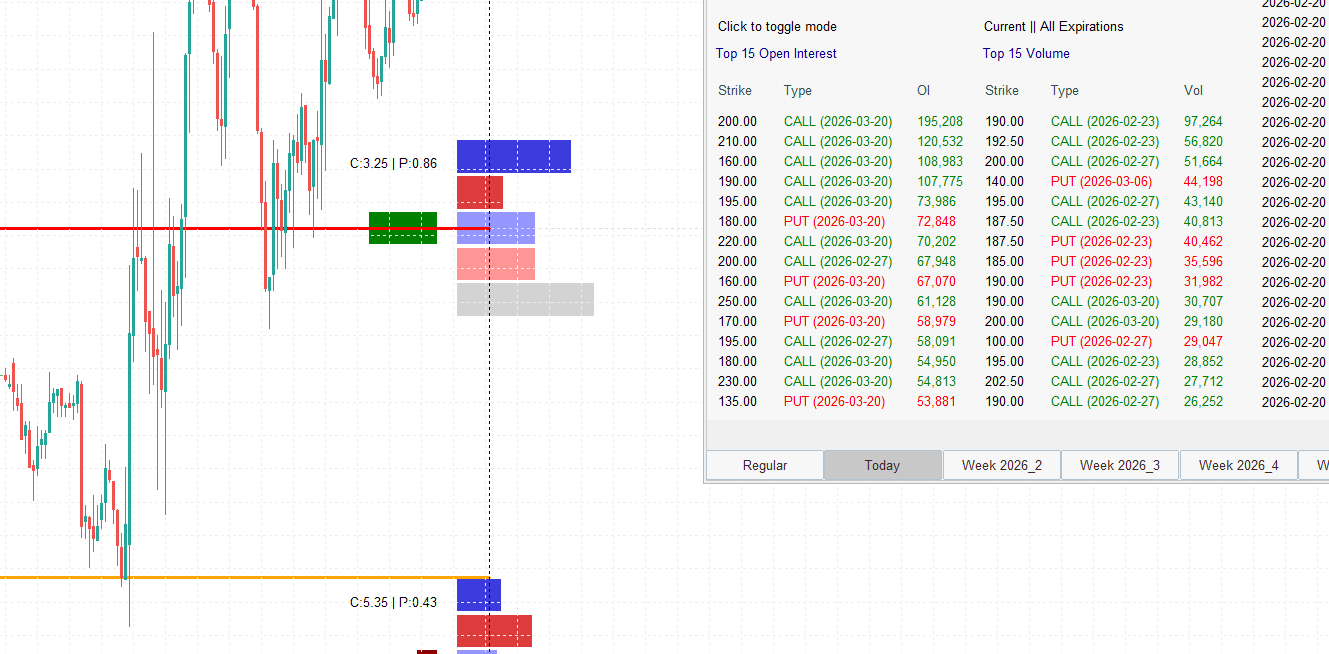
- OI/Volume Statistics — Layer 1 & 2: Top 15 OI and Top 15 Volume tables provide the structural map (Layer 1) and activity screen (Layer 2) simultaneously. Per-strike put/call ratio and V/OI ratio surface structural significance and activity anomalies in one panel. This is the starting point for every flow intelligence session.
- Real-Time Options Tape — Layer 3: The last 30 largest prints with timestamps, size, strike, expiration, and aggressor-side classification. Clustered ask-side prints on the same strike across multiple timestamps are the primary golden sweep and Accumulation archetype detection signal.
- ITM vs. ATM Positioning Module — Archetype Classifier: Automatically separates defensive ITM flow (Structural Hedging archetype) from speculative ATM/OTM flow (Accumulation or Speculative Burst archetypes) in real time. Flags the market’s current mode as Hedging or Speculative, compressing the first two steps of the decision tree into a single indicator.
- GEX Profile + ZGL — Regime Context: The GEX Profile and Zero Gamma Level provide the regime filter for every flow signal. Updated in real time as new options prints shift the net gamma balance. The ZGL overlay on the MT5 chart shows precisely where the regime boundary sits relative to current price.
- On-Chart HUD — Structural Integration: Max Pain level, ZGL, and Expected Move bounds overlaid directly on the price chart. Every structural signal is visible on the same canvas as price action, enabling the structural level check (step 6 of the decision tree) without leaving the trading window.
- Term Structure View — Roll Detection: Multi-expiration OI distribution makes roll signatures (near-term OI falling + further-dated OI rising at the same strike) immediately visible, automatically filtering the most common false positive from the flow signal set.
The Complete StrikeWatch Flow Intelligence Workflow
- Open GEX Profile. Identify the ZGL and the current regime (positive or negative gamma). Note the nearest structural support and resistance levels from the OI concentration heatmap.
- Check ITM vs. ATM Positioning. Is the module flagging Hedging Mode or Speculative Mode? If Hedging Mode dominant, shift to premium-selling strategy framework. If Speculative Mode active, proceed to Layer 2 screening.
- Scan Top 15 Volume for V/OI anomalies. Flag any strike where V/OI exceeds 1.0. Note whether calls or puts are dominant and at which expirations.
- Open Real-Time Tape for flagged strikes. Are the large prints ask-side (conviction) or bid-side (exit)? Are they concentrated in a single expiration (fresh positioning) or split across two expirations (roll)?
- Apply the Pre-Trade Checklist. Run all six conditions. Document the pass/fail for each. Calculate the convergence score (out of 6).
- Execute with regime-adjusted sizing. Below ZGL in negative gamma: standard size. Above ZGL in positive gamma: 50% size. Set stop at 50% of premium. Set target at 100–200%.
- Monitor OI change next morning. Did V/OI anomaly from yesterday result in rising OI (new positioning confirmed) or flat/falling OI (liquidation or roll)? This is the final confirmation gate for holding vs. exiting.
Three layers, not one indicator. OI structure (where capital is
committed), volume activity (where it is moving today), and tape aggression (how
urgently) must all be read simultaneously. Any single layer in isolation generates
noise. All three aligned generate signal.
Four archetypes cover all institutional behavior. Accumulation
(methodical buildup), Speculative Burst (urgent event-driven), Structural Hedging
(mechanical protection, no directional content), Distribution (smart money exit).
Only Accumulation and Speculative Burst produce directional alpha for new entries.
Distribution produces timing alpha for exits.
GEX regime is the follow-through multiplier. The same flow signal
in positive gamma produces dampened moves; in negative gamma it produces amplified
moves. Every flow signal requires a regime check before sizing. The highest-edge
setup in the entire framework is Accumulation or Speculative Burst in negative
gamma approaching the ZGL from below.
Convergence compounds probability; divergence signals risk. Four
or more conditions passing on the pre-trade checklist defines a high-conviction
entry. Flow-structure divergence (buying into a major call wall in positive gamma)
is not just a non-signal — it is often a high-probability mean-reversion
setup in the opposite direction.
Patience for maximum convergence is itself a skill. Maximum
convergence setups (all six checklist conditions + negative gamma regime +
structural alignment) occur 3–5 times per month on any liquid underlying.
Sizing these setups at full conviction and passing on lower-convergence noise
is the primary differentiator between systematic flow intelligence and
expensive noise-following.