Why Tail Risk Hedging Matters
Traditional asset allocation is built around average volatility. But equity markets periodically experience tail events: large, sudden drawdowns far beyond what a normal distribution would suggest. These episodes often compress years of volatility into weeks, overwhelming unhedged or leveraged portfolios.
Tail risk hedging is not about eliminating losses; it is about capping catastrophic drawdowns and preserving capital for compounding. This article focuses on hedging with index options and VIX–linked overlays, and on how to use StrikeWatch’s structural analytics — ZGL, GEX, Max Pain and volatility metrics — to time and design hedges that are both effective and cost–aware. For the integrated framework that places tail protection within the full four-layer risk management system, see Options Portfolio Risk Management Framework.
Defining Equity Tail Risk
In options language, tail events correspond to large negative returns beyond some threshold (e.g. daily moves worse than −3% or monthly drawdowns beyond −15%). These events are:
- Rare on historical frequency, but
- Dominant in their contribution to long–run risk and investor behavior.
Effective tail hedges aim to:
- Provide convex payoffs that grow faster than losses in severe selloffs.
- Carry a manageable cost in normal markets.
- Integrate with the portfolio’s beta and sector exposures rather than fighting them.
Instruments for Tail Hedging: SPX/NDX Puts and VIX Overlays
The two most commonly studied building blocks for equity tail hedging are:
- SPX/NDX (or ETF) puts and put spreads: Direct downside protection on the equity index; payout linked to the magnitude of the price drop.
- VIX calls or call spreads: Protection linked to volatility spikes that typically accompany equity selloffs. VIX options are European-style cash-settled instruments whose pricing depends on VIX futures, not the spot VIX — understanding the term structure is essential before sizing any VIX overlay. Full VIX mechanics and term structure in VIX Explained: How the Fear Index Works.
Research and strategy indexes often combine these:
- Long OTM SPX put spreads (e.g. 25–15 delta) as the primary crash hedge.
- Supplementary VIX call or call ratio spreads to benefit from volatility spikes when equity options are too expensive.
This combination targets high convexity in deep drawdowns while limiting carry cost in normal regimes.
ZGL, GEX, Max Pain and Volatility Regimes
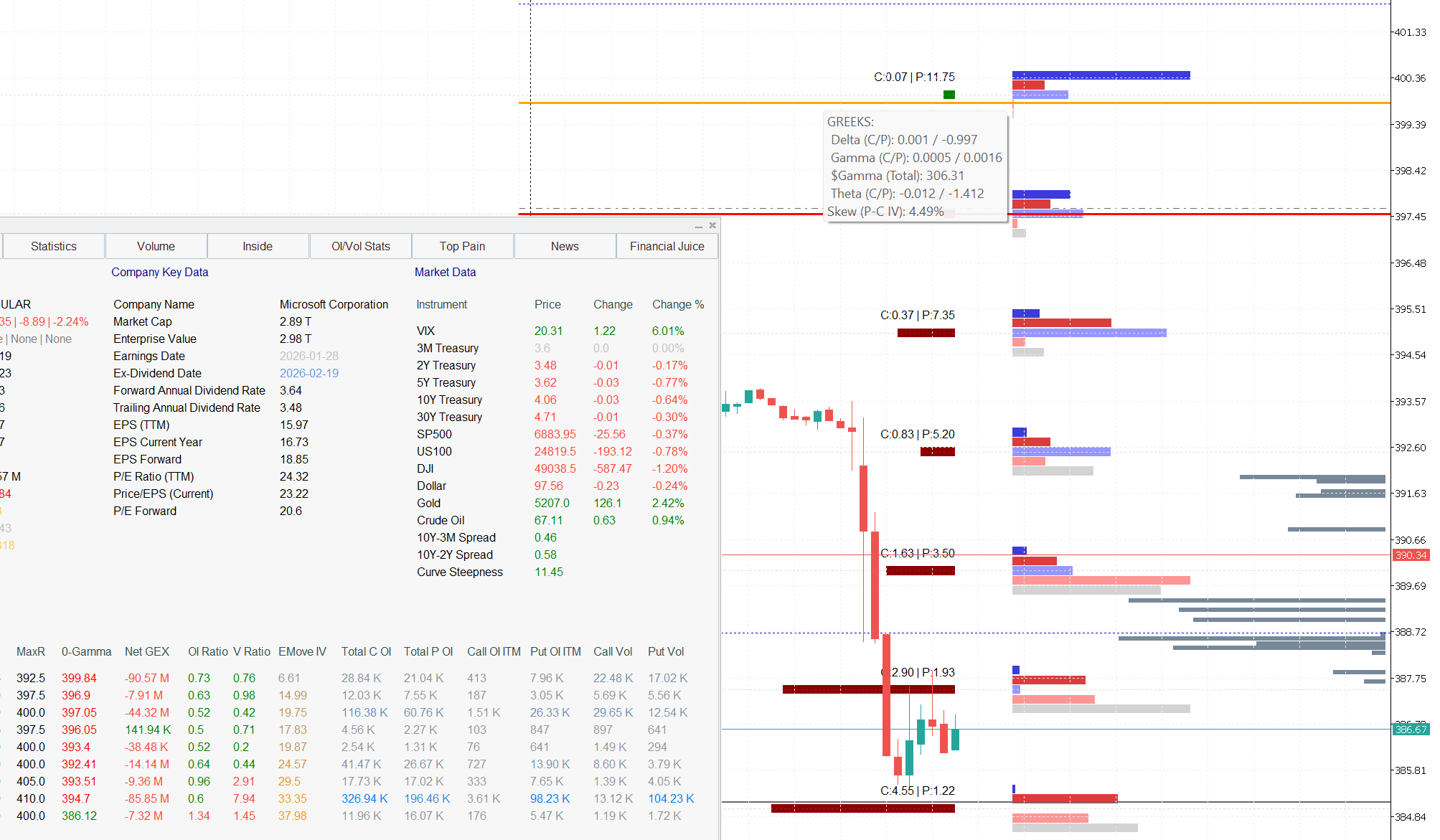
StrikeWatch offers structural indicators that are highly relevant for tail hedging:
- Gamma Exposure (GEX): Aggregate dealer gamma across strikes. Positive GEX regimes stabilize price; negative GEX regimes amplify moves. Understanding the full mechanics of how GEX shifts from stabilizing to destabilizing — and the role of the Zero Gamma Level as the flip point — is foundational to timing hedges efficiently. Full dealer mechanics in Dealer Hedging Regimes: GEX and Zero Gamma Level.
- Zero Gamma Level (ZGL): The price at which net GEX crosses zero — the volatility trigger where dealer hedging flips from stabilizing to destabilizing. When spot trades below ZGL, dealers sell into weakness and buy into strength, amplifying every directional move. This is the single most important structural entry signal for tail hedge additions.
- Max Pain: Strikes where option sellers maximize P&L at expiration, often associated with large OI clusters. In the context of tail hedging, Max Pain helps identify whether structural pinning forces are pulling price toward a relatively benign level near expiration, or whether the current price is far from any gravitational anchor and thus more vulnerable to a large move. Full Max Pain mechanics in Max Pain Theory: How Market Makers Pin Options Strikes at Expiration.
- Summary Surface: IVR, IVP, IV vs HV and VIX term structure (directly or via proxies) to characterize the volatility regime. These are the primary cost signals for hedge entry — covered in detail in Section 8.
Tail hedges are most valuable when:
- Price trades near or just above ZGL, with the risk of a slip into negative gamma.
- GEX is modest or negative in the region below spot, implying limited dealer support.
- IVR and VIX are relatively low or moderate, making long convexity cheap relative to historical stress episodes.
Designing SPX/Index Put and Put-Spread Hedges
Pure long puts offer the cleanest tail protection but can be expensive to roll indefinitely. Many systematic overlays therefore use put spreads to cap cost and focus on severe drawdowns.
| Structure | Profile | Pros | Cons |
|---|---|---|---|
| Long ATM/near-ATM puts | Strong protection for moderate and large drawdowns. | Simple, high convexity. | Highest carry cost; sensitive to IV crush if crisis does not materialize. |
| OTM put spreads (e.g. 25–15 delta) | Kick in after a threshold drawdown; capped payout. | Lower cost of carry; still strong convexity in deep tails. | No protection beyond lower strike; less helpful for small corrections. |
| Staggered ladders of puts | Several expiries (e.g. 1, 2, 3 months) held simultaneously. | Reduces timing risk; smoother hedge profile through time. | More complex to manage; higher transaction cost. |
Strike selection for put spreads should be grounded in the options market’s own implied range for the underlying. The Expected Move — derived from ATM straddle pricing or the IV formula — gives a statistically consistent boundary for choosing short and long put strikes. Placing the long put strike at roughly 1× expected move below spot and the short at 1.5–2× expected move focuses the hedge on statistically meaningful tail territory without over-buying protection at trivially distant strikes. Full expected move calculation methodology in Expected Move in Options: Formula, Strike Selection and GEX Confluence.
A common tail overlay approach is to:
- Allocate a fixed fraction of portfolio NAV (e.g. 1–3% per year) to rolling OTM index put spreads.
- Target hedge notionals of 15–30% of equity exposure, balancing drawdown reduction and cost.
- Concentrate hedges in maturities where structural GEX and ZGL suggest heightened vulnerability.
VIX Calls and VIX-Based Overlays
VIX options offer a complementary dimension: they pay off directly on volatility spikes, which often exceed the move in equity prices during crises. Key features:
- Convexity in crises: OTM VIX calls can return multiples of their cost when volatility explodes.
- Diversification: VIX responds to both downside moves and rising uncertainty, offering a different payoff path than pure index puts.
- Term structure sensitivity: VIX options are priced off VIX futures, not spot VIX. When the VIX futures curve is in strong contango — as it is most of the time — OTM call buyers face negative roll yield that erodes value. Adding VIX calls when the curve is flat or in backwardation dramatically improves the carry profile. Full VIX term structure mechanics and contango dynamics in VIX Explained: How the Fear Index Works.
Example design drawn from research and index strategies:
- Allocate a minority of hedge notional (e.g. 20–30% of total hedge budget) to OTM VIX call or call ratio spreads.
- Stagger expiries (e.g. 30, 60, 90 days) to reduce timing risk and dependence on a single roll date.
- Scale exposure with VIX level and term structure: add when VIX is low relative to history and the term structure is upward–sloping.
Sizing Hedges Relative to Portfolio Value
Sizing is where tail hedging becomes art as well as science. Empirical studies and practical indexes often use rules such as:
- Hedge notional: 10–30% of equity NAV, depending on risk tolerance and hedge design.
- Premium budget: 1–3% of portfolio per year in expected premium outlay (net of any offsetting carry from selling wings, where appropriate).
- Dynamic scaling: Increase hedge size when ZGL is near or above spot and GEX is modest or negative; decrease when price is far above ZGL in strong positive gamma with elevated IV.
A simple starting point is to choose a target maximum drawdown (e.g. −20%) you are willing to accept and back–engineer the hedge notional and structure that historically would have delivered that outcome in past crises.
It also helps to view hedge sizing through a portfolio vega lens. A long put or put-spread overlay adds positive vega to the book. For a portfolio that is primarily running short-vega income strategies — covered calls, credit spreads, iron condors — the hedge directly offsets part of the aggregate vega exposure, making space within the vega budget for additional income positions. Conversely, if the book is already long vega through LEAPS or long straddles, adding more positive-vega hedges requires checking whether the combined vega exceeds the portfolio limit. For the systematic methodology for setting and monitoring portfolio-level vega limits alongside delta, gamma and theta budgets, see Portfolio-Level Greeks: Managing Delta, Gamma, Theta and Vega Across Your Book. For the dollar-level position sizing rules that govern how much premium budget is available for hedges in the first place, see Options Risk Management and Position Sizing Guide.
When Hedges Are Cheap vs Expensive
Buying tail protection indiscriminately can be ruinous for long–term returns. You want to concentrate hedge purchases when:
- IVR and VIX are in the lower half of their historical distributions (volatility “on sale”). The IV Rank (IVR) and IV Percentile (IVP) metrics in StrikeWatch’s Summary Surface provide exactly this context — positioning current IV relative to its trailing distribution. When IVR is below 30, long convexity is historically cheap. Full IVR/IVP methodology and the IV–HV spread signal in Implied vs. Historical Volatility: What the Market Is Really Pricing.
- Price is near ZGL or GEX suggests vulnerability (limited dealer support below spot).
- Macro and credit conditions hint at brewing stress that is not fully priced into options yet.
Conversely, hedges are typically expensive when:
- IVR and VIX are already elevated, reflecting recent fear. In this environment, buying puts means paying a significant volatility risk premium to the market maker — premium that would have been cheap a month earlier. The VIX term structure provides an additional signal: if VIX futures are already in backwardation (front month above back months), tail fear is already priced in aggressively. VIX term structure interpretation in VIX Explained: How the Fear Index Works.
- GEX is strongly negative but markets have already sold off; future convexity may still be attractive, but carry cost is higher.
- Max Pain and OI clusters sit far from current price, implying structural drift may mean–revert rather than continue in a straight line.
The ideal hedge entry window is low IVR + near-ZGL + upward-sloping VIX term structure. All three together mean protection is cheap, structural vulnerability is rising, and the vol market is not yet pricing fear. This window typically appears during calm, range-bound markets in positive-GEX regimes — exactly when most traders feel the least urgency to hedge.
Tail Hedging Workflow with StrikeWatch EA
A practical StrikeWatch–driven workflow for tail hedging:
- Structural scan: Check ZGL and GEX for SPX/NDX (or proxies). Note whether spot is close to ZGL and whether the regime is positive or negative gamma. Regime classification and the implications for dealer hedging behavior are in Dealer Hedging Regimes: GEX and Zero Gamma Level.
- Volatility assessment: Use Summary Surface to inspect IVR/IVP, IV vs HV and VIX proxies for the relevant indices. Is IV in the lower half of its distribution (favorable to buy convexity) or already elevated (expensive)? Framework for interpreting these signals in Implied vs. Historical Volatility.
- Hedge construction: Design a mix of OTM index put spreads and VIX call/call–spread structures. Size to your target hedge notional and premium budget as defined in your dollar risk framework — Options Risk Management and Position Sizing Guide. Use the Expected Move to anchor strike selection — Expected Move in Options.
- Execution: Use OI & Flows and Volume modules to choose liquid strikes and maturities. Executing near high-volume nodes (HVNs) in the underlying ensures that hedge strikes correspond to levels with genuine institutional liquidity. Volume floor methodology in Volume Profile, Auction Market Theory and Liquidity Density. OI cluster analysis in Open Interest vs. Volume in Options.
- Monitoring and rolls: Roll hedges forward on a fixed calendar (e.g. monthly) or when Summary and structural metrics indicate a regime change. Key trigger: if ZGL moves above spot (spot enters negative-gamma territory), treat that as a priority roll signal regardless of calendar schedule.
Over time, this turns tail hedging from an ad–hoc reaction into a systematic overlay that operates on the same structured process as the rest of your options portfolio.
Common Tail Hedging Mistakes
Even well–intentioned hedging can backfire. Frequent pitfalls include:
- Hedging too much, too often: Over–allocating to expensive ATM puts in calm regimes, destroying long–term returns. The 1–3% annual premium budget is a ceiling, not a target — in low-IVR environments the actual cost should be well below it.
- Hedging at the wrong time: Buying hedges only after large drawdowns and IV spikes, locking in high prices and poor forward expectancy. The timing framework in Section 8 addresses this directly.
- Ignoring structure: Building hedges without reference to GEX, ZGL, Max Pain or volume, resulting in protection that kicks in at structurally unlikely levels.
- No integration with portfolio: Hedge notionals unrelated to actual equity exposure, leading to under– or over–protection. The hedge notional should always be calibrated to the portfolio’s actual beta-adjusted equity exposure, not to a round number.
- Treating hedges as optional: Systematically skipping the hedge budget because recent markets have been benign. The cost of tail protection is precisely lowest when the urgency feels lowest — that is the optimal time to add it, not a reason to defer.
By combining academically informed hedge structures with StrikeWatch’s real–time structural analytics, you can avoid most of these errors and build tail protection that does what it is supposed to do: keep you in the game when everyone else is forced to sell.
Key Takeaways
- Tail risk hedging is Layer 4 of the four-layer options risk management system. For the full integrated framework, see Options Portfolio Risk Management Framework.
- The most efficient tail hedge combines OTM SPX/NDX put spreads (primary crash hedge) with VIX call overlays (volatility spike protection). The combination targets convexity in deep drawdowns while limiting carry cost in normal regimes.
- Strike selection for put spreads should be anchored to the options market’s own expected move, not to arbitrary round-number distances from spot. See Expected Move in Options.
- The optimal entry window is low IVR + near-ZGL + upward-sloping VIX term structure. All three together produce the lowest-cost, highest-urgency hedge opportunity.
- Hedge sizing (10–30% of equity NAV, 1–3% annual premium budget) must be calibrated against the portfolio’s actual vega exposure. Long puts add positive vega that offsets short-vega income positions. See Portfolio-Level Greeks.
- GEX and ZGL are the primary structural timing signals for hedge additions and rolls. A ZGL breach by spot is a priority roll trigger regardless of the calendar schedule. See Dealer Hedging Regimes: GEX and ZGL.
- VIX overlay sizing and entry require understanding the VIX futures term structure, especially contango dynamics that erode OTM call value in quiet markets. See VIX Explained: How the Fear Index Works.