What Is Max Pain?
Max Pain — formally called the Maximum Pain Point or Options Pain — is the strike price at which the total dollar value paid out to all option holders (both calls and puts) is mathematically minimized at expiration. Equivalently, it is the price at which option sellers — primarily market makers and dealers — retain the maximum amount of the premium they collected.
The concept rests on a straightforward observation: dealers and institutions who sell options are structurally short premium. Their hedging activity and liquidity provision create a financial incentive directionally aligned with price converging toward the Max Pain strike as OPEX (options expiration day) approaches. The degree to which this produces actual price convergence is the subject of ongoing academic and practitioner debate — but the empirical evidence for high open-interest underlyings such as SPX, SPY, QQQ, AAPL, and NVDA is compelling.
Max Pain does not operate in isolation. It functions inside a larger structural cycle: the monthly and quarterly OPEX rhythm in which gamma accumulates over several weeks, peaks in the final days before expiration, and then vanishes as contracts settle. Understanding where in that cycle the market currently sits — including how much gamma will roll off after the expiration — is essential context for applying Max Pain correctly. For the complete OPEX gamma cycle framework, including the post-expiration window of weakness and call-weighted versus put-weighted dynamics, see Options Expiration Cycle: OPEX, Gamma Dynamics, Assignment & Pin Risk.
Max Pain is not price prediction. It is a gravitational reference level — a statistical attractor near expiration, not a deterministic target. Its predictive power increases sharply within the 0–3 DTE (days to expiration) window before OPEX and is weakest more than one week out. The strongest version of the effect is observed on 0DTE (zero days to expiration) expirations, especially during OPEX Friday afternoon.
The Mathematics of Max Pain
The calculation is methodical. For every possible expiration price P — iterating across all listed strikes — you compute the total dollar payout to all call and put holders:
Pain(P) = ∑ max(P − Ki, 0) × OIcall,i + ∑ max(Kj − P, 0) × OIput,j × 100
Where Ki = call strike, Kj = put strike, OI = open interest (number of open contracts), 100 = shares per contract.
Max Pain = argminP Pain(P) — the price minimizing total dealer payout.
In plain language: for each candidate expiration price, you add up how much every ITM (in-the-money) call and every ITM put would collectively pay out. The price that minimizes this total payout is the Max Pain point. It often coincides with the strike that has the highest total open interest — but not always. The balance between calls and puts at each level is what truly determines the minimum.
| Strike (P) | Call Payout ($M) | Put Payout ($M) | Total Pain ($M) | Interpretation |
|---|---|---|---|---|
| 470 | 0 | 182.4 | 182.4 | Heavy put payout — far from optimum |
| 480 | 8.2 | 94.6 | 102.8 | Improving — puts still dominate |
| 490 | 21.5 | 38.1 | 59.6 M (Min) | Max Pain Strike — dealer payout minimized |
| 500 | 68.3 | 12.4 | 80.7 | Call payout rises steeply |
| 510 | 143.9 | 4.1 | 148.0 | Call-heavy — far from optimum |
Why Price Gravitates Toward Max Pain
The gravitational pull toward Max Pain is not a conspiracy — it is an emergent consequence of gamma-driven delta hedging and liquidity provision asymmetry. As expiration approaches, gamma on ATM (at-the-money) options explodes, forcing dealers to rebalance enormous notional positions with each small price increment. This hedging activity dampens moves away from high open-interest strikes and amplifies mean-reversion back toward them. For a full treatment of how dealer delta-hedging works and why it can dominate short-term price action, see Dealer Hedging Regimes: GEX and the Zero Gamma Level.
Specifically, two forces reinforce each other. First, as expiration nears, gamma on ATM options spikes sharply — a $0.01 move in price can flip the delta of millions of dollars of open interest from 0 to 100, forcing dealers to hedge enormous notional positions with urgent market orders. Second, dealers who are net short options — the typical structural position — have a rational incentive to provide liquidity in the direction that keeps price near Max Pain: buying when price falls below it (defending heavy put OI walls), and selling when price rises above it (defending heavy call OI walls). Neither of these is coordinated manipulation. Both are the mechanical consequence of running a delta-neutral book at scale.
This mechanical pressure is strongest when the most gamma is expiring — which is why quarterly OPEX events produce the most observable pinning. In a standard monthly cycle, post-expiration gamma roll-off of 20–40% weakens the floor and creates the structural window of vulnerability that follows. Max Pain itself becomes irrelevant once that expiration settles: all prior OI is wiped, and the new cycle begins from near-zero. For a complete treatment of these before- and after-OPEX structural shifts, see Options Expiration Cycle: OPEX, Gamma Dynamics, Assignment & Pin Risk.
The Pin Risk Window: When Max Pain Is and Is Not Valid
Pin Risk is the phenomenon where price becomes stuck near a high open-interest strike as expiration approaches. It is not a permanent condition — it is a time-decaying effect that peaks at 0DTE and dissipates entirely once contracts expire. Understanding when the Max Pain effect is active is critical: applying it outside its valid window is one of the most common ways traders misuse this tool.
| DTE (Days to Expiry) | Max Pain Relevance | Primary Driver | Suggested Use |
|---|---|---|---|
| 10+ DTE | Very low | Macro, earnings, news flow | Ignore — use GEX and ZGL instead |
| 5–9 DTE | Low to moderate | Trend + early gamma buildup | Awareness only, not actionable |
| 2–4 DTE | Moderate | Gamma hedging begins to dominate | Watch as secondary structural level |
| 0–1 DTE | High | Pin risk, gamma explosion, dealer hedging | Primary expiration target |
| OPEX Friday PM | Very high | Final gamma hedging, pin risk at maximum | High-conviction mean-reversion target |
Pin Risk only applies in low-news environments. A major macro event (FOMC decision, CPI print, earnings surprise) within the pin window overrides Max Pain mechanics entirely. The post-event IV (implied volatility) crush can then reassert the pin, but the event move itself is structurally unconstrained. Always check the economic calendar before applying Max Pain as a trading target.
Local Pain vs. Global Max Pain
The standard Max Pain calculation has a well-known flaw: deep OTM (out-of-the-money) strikes with residual open interest can distort the global minimum toward unrealistic price levels — sometimes far outside the current expected move range. This makes the raw global calculation unreliable as a short-term pin target.
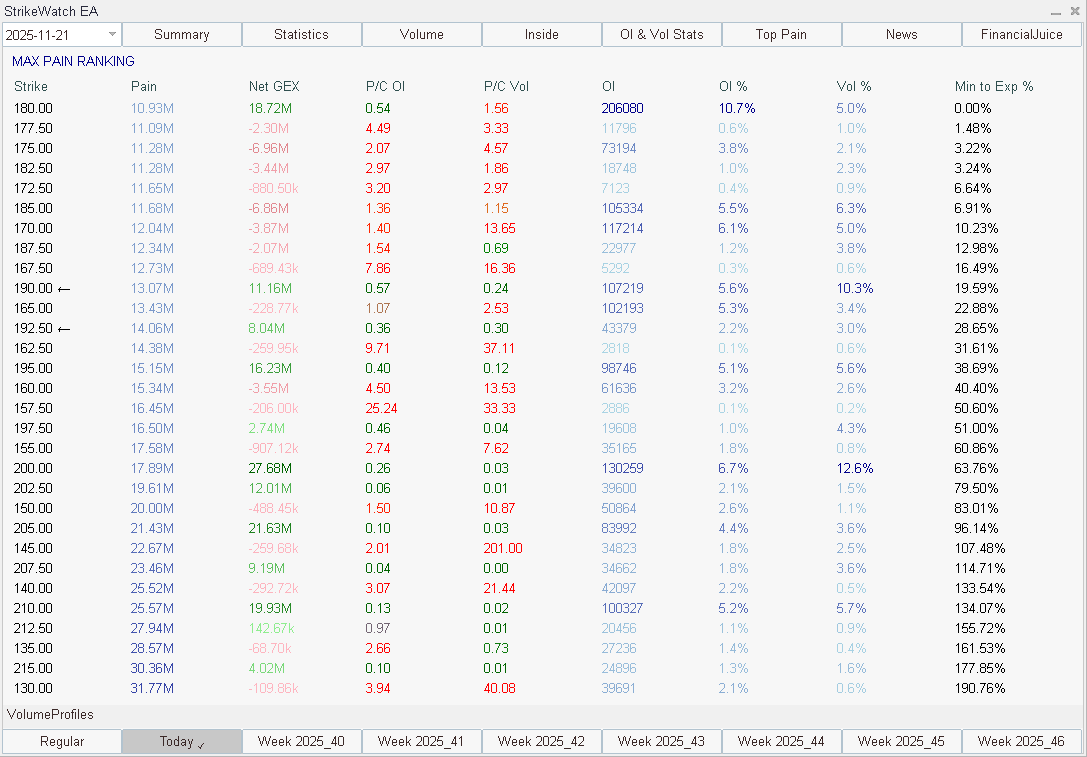
StrikeWatch EA addresses this by computing a Local Pain value: the minimum-pain strike constrained to within 2 standard deviations of the current price, using the IV-derived expected move as the boundary. This range-aware Max Pain filters out deep OTM distortions and produces a far more actionable intraday pin reference.
The expected move boundary is calculated from the at-the-money straddle price for the target expiration: Expected Move ≈ ATM straddle price × 0.84 for approximately ±1 standard deviation. Constraining the Local Pain calculation to within this range eliminates strikes where delta-hedging activity is negligible — ensuring the output reflects only structurally live positioning. For the full expected move formula, boundary derivation, and how to use it to frame realistic expiration ranges, see Expected Move in Options: Formula, Strike Selection and GEX Confluence.
The Put/Call Ratio Per Strike
Beyond the aggregate pain curve, examining the Put/Call Ratio (PC Ratio) — the ratio of put open interest to call open interest at each individual strike — reveals the directionality of positioning at each structural level. A strike with a PC Ratio below 0.5 (call-heavy) acts as a ceiling: dealers are net short upside gamma and will sell into rallies toward that level. A strike with a PC Ratio above 2.0 (put-heavy) acts as a floor: dealers are net short downside gamma and will mechanically buy dips toward that level. Max Pain is simply the aggregate balance point of all these local opposing forces.
The per-strike PC Ratio is distinct from the aggregate Put/Call Ratio used as a market-wide sentiment indicator. At the individual strike level, it tells you the directional character of a wall — whether it represents a ceiling or a floor — rather than broad market fear or greed. For the complete methodology on how to read the aggregate PCR as a contrarian sentiment signal, including volume vs. OI PCR distinctions and term structure effects, see Put/Call Ratio: Sentiment, Positioning & Structure Guide.
Using Max Pain as a Trading Tool
Applied correctly, Max Pain integrates into a broader options-structure framework rather than operating as a standalone signal. The five highest-value use cases are:
- Weekly expiration target (0–2 DTE) — On Tuesday through Thursday of expiration week, identify the weekly Max Pain strike. If price is within 1–2% of this level, a mean-reversion trade targeting the exact strike by Friday close has a statistically favorable skew, provided no macro catalysts are present.
- Monthly OPEX positioning — Monthly OPEX (third Friday) carries the heaviest open interest of any expiration cycle. The Max Pain effect is strongest for these expirations. Use the monthly Max Pain strike as a macro range anchor for the entire expiration week, not just the final session.
- GEX confluence zones and Strike Wall scoring — When the Max Pain strike coincides with a high positive GEX (Gamma Exposure) concentration from the dealer gamma profile, you have a double gravity point: both pin mechanics and positive-gamma hedging align. These are the highest-conviction pin targets in the framework. To convert this confluence into a structured, scored decision, apply the four-layer strike wall framework in Strike Wall Analysis: OI, GEX, PCR and Max Pain. A Max Pain proximity score of 1/4 added to GEX magnitude (1/4), OI concentration (1/4), and PCR directional bias (1/4) produces a 4/4 Maximum Conviction Wall — the highest-reliability structural setup in Domeny A.
- Range definition — Use Max Pain ± 1 standard deviation (IV-derived expected move) as a probabilistic range for expiration week. Price straying meaningfully beyond this range requires either a strong directional catalyst or a GEX regime change to sustain.
- Premium selling context — When selling premium (straddles, strangles, iron condors), centering your short strikes on or near Max Pain increases the probability of maximum profit — since this is the level at which market structure mechanically wants to close.
Limitations and When It Fails
Misapplying Max Pain is a common retail mistake. Understanding its failure modes is as important as understanding its strengths:
- Low open-interest underlyings — Max Pain requires significant options liquidity to generate real gravitational force. For small-cap or thinly-traded names, the mechanics are unreliable. Stick to the top 50 underlyings by options volume for consistent signals.
- Strong trending environments — In a clear macro trend (a sustained bear market decline, for example), Max Pain will consistently be violated. Trend force overwhelms hedging mechanics. Always confirm the GEX regime before applying Max Pain as a mean-reversion tool.
- Earnings-week expirations — When an earnings announcement falls within the expiration window, IV expansion dwarfs Max Pain mechanics. The post-earnings IV crush can then reassert the pin — but the earnings move itself is structurally unconstrained.
- Max Pain shifts during the week — As options are opened, closed, and rolled, the Max Pain strike changes. A snapshot from Monday may be irrelevant by Wednesday. Always use a real-time calculation — never a static value pulled from a weekly external source.
- Treating it as a directional signal — Max Pain does not tell you which way price will move to reach the pin — only where the destination is. Price can approach the Max Pain strike from either direction with equal mechanical logic.
Common Misconceptions
Max Pain attracts more misunderstanding than almost any other options concept. These are the errors that appear most frequently in practice:
- Max Pain always works. It works probabilistically in the right environment: high-OI underlier, low-catalyst window, 0–2 DTE. Outside that window, it is background noise, not signal.
- Max Pain is where price will close. It is a gravity zone, not a destination guarantee. Price can settle anywhere within the expected move range on any given expiration — even when Max Pain mechanics are fully in play.
- Max Pain and the ZGL are the same thing. They are not. The Zero Gamma Level (ZGL) is where aggregate dealer gamma crosses from positive to negative — a regime boundary. Max Pain is where the total payout is minimized — a payout optimization. They can and often do sit at different price levels, and they carry different information.
- Max Pain is market manipulation. The mechanism is structural, not conspiratorial. Dealers delta-hedge mechanically. The resulting price pressure toward high-OI strikes is a mathematical consequence of running a large short-premium book, not coordinated collusion.
- Any Max Pain number is reliable. Deep OTM open interest distorts the global calculation. The Local Pain value — range-constrained to the current expected move — is far more actionable for intraday pin targeting.
- Max Pain replaces GEX analysis. The two tools answer different questions. GEX tells you how dealer hedging will behave across the full price range and defines the volatility regime. Max Pain tells you where payout mechanics are pointing near expiration. Used together — through the Strike Wall scoring framework in Strike Wall Analysis — they provide a far more complete structural picture than either does alone.
Max Pain Inside StrikeWatch EA
StrikeWatch EA eliminates all manual Max Pain calculation overhead. The full suite of Max Pain tools is built into MetaTrader 5 and recalculates continuously as live options data updates:
- Real-time pain curve — The full pain curve is recalculated on every data refresh, iterating across every listed strike for the selected expiration. You see the precise minimum — not an approximation and not a stale third-party snapshot.
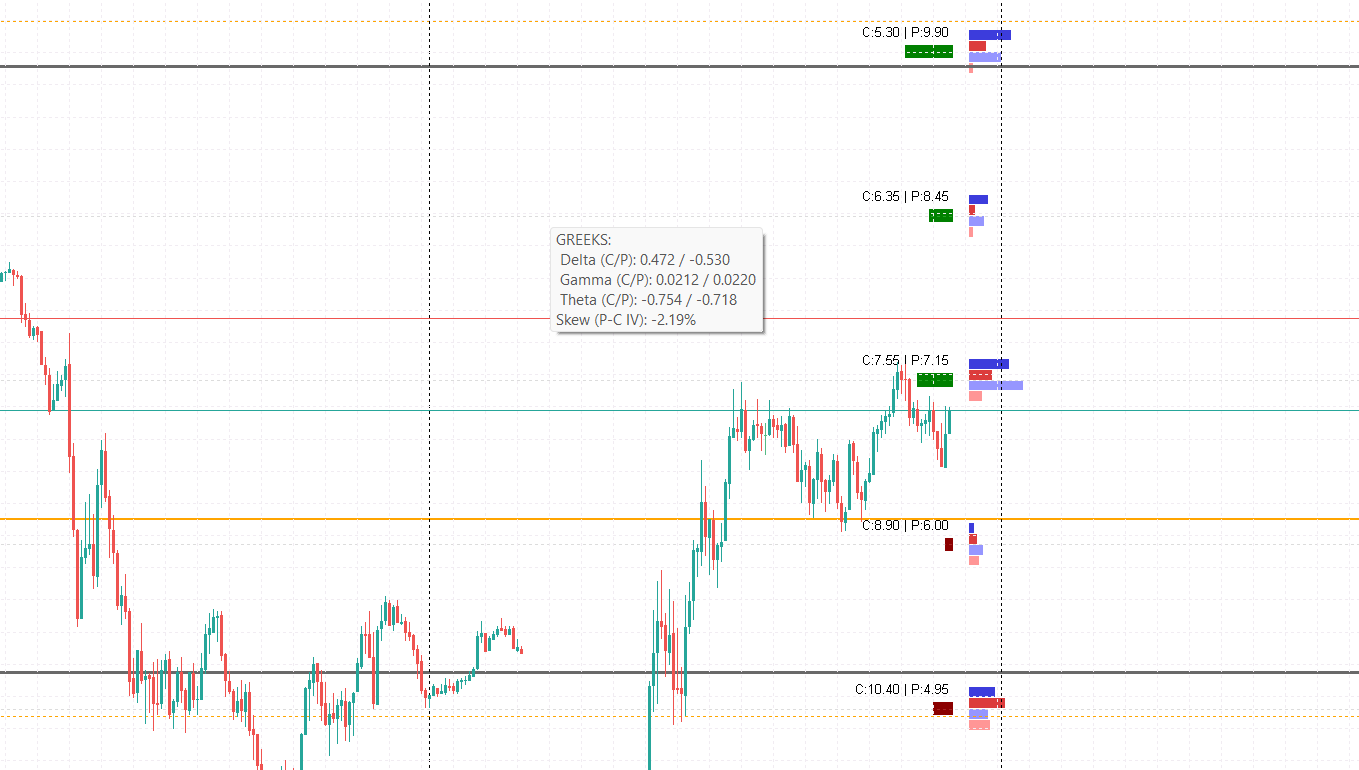
- On-chart Max Pain line — The Max Pain strike is plotted as a dynamic horizontal line directly on your MT5 price chart via the On-Chart HUD, alongside the Zero Gamma Level and expected move bounds, giving you the complete structural picture in one view.
- Local Pain filter — The engine automatically computes the range-constrained Local Pain value, filtering out deep OTM distortions for a more actionable intraday pin target.
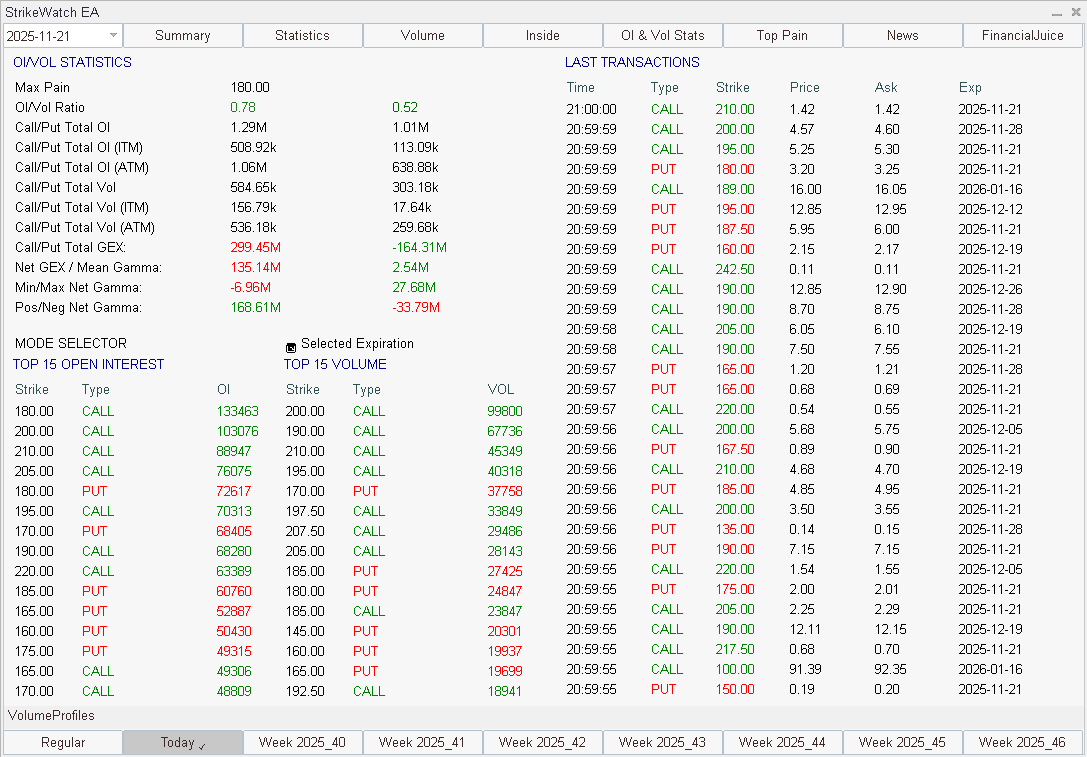
- Per-strike PC Ratio — The OI/Volume Statistics module displays the put/call open interest ratio for every strike in the Top 15 scanner, letting you understand the directional bias of each support and resistance wall instantly.
- Multi-expiration view — The Summary Surface module shows Max Pain for up to 10 expiration dates simultaneously in the Term Structure heatmap — so you can see how the pin target shifts across the options calendar at a glance, not just for the nearest expiry.
- GEX + Max Pain confluence detection — When the Max Pain strike aligns with a dominant positive-GEX concentration, the interface flags the overlap, surfacing the double-gravity setups that carry the highest structural conviction.
- Strike Wall scoring integration — The Max Pain level feeds directly into the four-layer wall scoring engine in the OI/Volume Statistics module. Any candidate wall within 0.5% of Max Pain automatically receives the fourth scoring point, enabling the full 4/4 Maximum Conviction Wall designation without manual cross-referencing.
A Pre-Expiration Checklist
A focused pre-market routine near OPEX can convert Max Pain from abstract theory into a repeatable decision-support tool:
- What is the current Max Pain strike for the nearest expiration?
- How far is spot from Max Pain in percentage terms?
- Does the Max Pain strike align with a high positive-GEX concentration?
- What is the PC Ratio at the Max Pain strike — is it balanced, call-heavy, or put-heavy?
- Is there a macro catalyst (FOMC, CPI, earnings) within the expiration window?
- Which DTE window are we in — is Max Pain structurally relevant today?
- Does the broader GEX regime support mean reversion, or is the ZGL breached?
- What is the Strike Wall score at the Max Pain level? Apply the four-layer framework from Strike Wall Analysis: OI, GEX, PCR and Max Pain. If the Max Pain strike scores 3/4 or 4/4 — with OI, GEX, and PCR all confirming — it represents the highest-conviction structural setup available before that expiration.
Eight questions. Answering them takes under three minutes with StrikeWatch EA and immediately frames whether the session is a structural pinning environment or one where Max Pain should be sidelined in favor of directional regime tools.
Max Pain is the strike where total dealer payout is minimized at
expiration. It acts as a gravitational attractor — not a directional forecast.
The effect is time-gated: highest reliability in the 0–2 DTE
window, weakest beyond 5 DTE. Macro catalysts override it entirely.
Local Pain (range-constrained) is more actionable than the global
calculation for intraday pin targeting.
Max Pain + GEX confluence creates the highest-conviction pin setups
— two separate structural forces pointing at the same strike.
Max Pain + Strike Wall scoring converts the gravitational signal into a
structured 0–4 conviction score. A 4/4 Maximum Conviction Wall at the Max Pain
strike is the highest-reliability setup in the framework. Full scoring system in
Strike Wall Analysis: OI, GEX, PCR and Max
Pain.
Max Pain ≠ ZGL. They measure different things and often sit at
different levels. Use them together, not interchangeably.
Real-time calculation matters: a stale Max Pain value from earlier in
the week can be significantly displaced from the live level as positions are rolled and
opened. StrikeWatch EA recalculates continuously.
OPEX cycle context matters: Max Pain operates inside the larger monthly
and quarterly gamma accumulation cycle. For the structural framework that surrounds it
— including post-OPEX gamma roll-off and assignment mechanics — see
Options Expiration Cycle:
OPEX, Gamma Dynamics, Assignment & Pin Risk.