What Options Expiration Really Changes
Options expiration is not just the moment when a contract stops trading. It is a recurring structural event that changes dealer hedging flows, removes or concentrates gamma exposure, alters the probability of price pinning near major strikes, and creates very real assignment and execution risks for traders.
That is why expiration week often feels different from an ordinary trading week. Price can become more compressed around large open-interest strikes, then more unstable once that gamma rolls off. At the same time, traders holding short contracts near the money face operational risks that have nothing to do with chart patterns and everything to do with settlement mechanics. The full convergence of these structural forces — open interest concentration, gamma exposure, put/call ratio bias, and Max Pain gravity — is mapped in the Strike Wall Analysis framework, which provides the complete scoring system for identifying which strikes will be mechanically defended into any expiration.
Expiration matters for three reasons at once:
Market structure — gamma builds into OPEX and disappears after it.
Price behavior — strike pinning and gravitational pull become more relevant
near expiry.
Trader risk — assignment, auto-exercise, and pin risk can create unexpected
outcomes.
What Options Expiration Actually Is
Options expiration is the date and time at which an options contract ceases to exist. After expiration, the contract is either exercised if it is in the money, assigned if you are the seller on the other side, or expires worthless if it finishes out of the money. The Options Clearing Corporation (OCC) handles the exercise and assignment process automatically.
The mechanics are straightforward: any option that is $0.01 or more in the money at expiration is generally automatically exercised unless the holder submits a "do not exercise" instruction. This means that even a slightly ITM option you forgot about can turn into an unexpected stock position on the next session.
Options do not technically expire at 4:00 PM ET on Friday. The market close and the exercise deadline are not the same event. That gap between the end of regular trading and the final exercise process is exactly what creates the window where pin risk and after-hours movement can change the outcome.
Automatic exercise rules
- Options $0.01 or more in the money are generally automatically exercised.
- Options exactly at the money are generally not automatically exercised.
- Out-of-the-money options expire worthless.
- Holders can override the standard outcome by submitting contrary instructions through their broker.
Expiration Cycles: Monthly, Weekly, and Quarterly
The options market operates on three overlapping expiration cycles, each with different volume profiles, open-interest concentrations, and structural effects.
| Cycle | Frequency | Expiration Day | Key Characteristics |
|---|---|---|---|
| Monthly | 12 per year | Third Friday of each month | Highest open interest, strongest strike pinning effect, standard institutional positioning |
| Weekly | Frequent, often multiple per week | Varies by product | Lower OI per expiry, higher short-term gamma concentration, central to 0DTE trading |
| Quarterly | 4 per year | Third Friday of Mar, Jun, Sep, Dec | Futures overlap, witching effects, largest structural gamma roll-off events |
Monthly expiration remains the most important recurring structural cycle for many underlyings because it concentrates the heaviest positioning. Weekly expirations matter more for tactical short-term gamma trading, while quarterly expirations can reshape the market on a much larger scale.
Quadruple Witching
Four times per year, stock options, stock index futures, stock index options, and single-stock futures all expire on the same day. These Quadruple Witching dates often produce the highest-volume sessions of the year as institutions roll, close, and rebalance positions across all four product classes simultaneously.
Witching sessions can produce highly erratic final-hour trading because position-management flow overwhelms ordinary directional trading. They should be treated as structurally special sessions rather than routine expirations.
The Monthly Rhythm of Gamma
Options markets operate on a cycle. New positions are opened after one expiration, gamma accumulates as open interest builds, peaks in the final week before the next expiration, and then vanishes as contracts settle. This recurring rhythm — the OPEX cycle — creates a repeatable pattern of volatility compression and expansion that institutional desks have traded around for decades.
The mechanics are straightforward: as open interest grows in the weeks leading up to expiration, the total Gamma Exposure (GEX) held by market makers increases. In a typical call-weighted environment, rising positive gamma forces dealers to buy dips and sell rallies in progressively larger size, mechanically compressing realized volatility. Then, on expiration Friday, that gamma disappears. The mechanical support evaporates, and the market loses part of its structural guardrail. For a complete treatment of GEX mechanics and dealer hedging regimes — including how the Zero Gamma Level (ZGL) shifts as gamma rolls off after OPEX — see Dealer Hedging Regimes: GEX and the Zero Gamma Level.
In positive-gamma environments, the market often exhibits a flat-to-positive bias during OPEX week as expanding gamma pins price and compresses implied volatility. Post-OPEX, approximately 20–40% of total positive gamma can roll off, weakening the dealer cushion and creating what traders call the window of weakness — a 3-to-5-day period in which the market is structurally more vulnerable to a pullback or sideways consolidation.
Call-Weighted Versus Put-Weighted Expirations
Not all expirations are created equal. The composition of the expiring gamma determines whether the post-OPEX environment will be merely soft or outright dangerous.
Call-Weighted OPEX: Positive Gamma Dominant
When more calls are set to expire than puts, the expiring gamma is predominantly positive. During OPEX week, this positive gamma supports the market. Dealers buy dips as hedge adjustments create a mechanical floor under price, while implied volatility compresses as the pinning effect intensifies.
Post-expiration, the loss of this positive gamma removes the floor. The market does not necessarily crash, but it loses structural support. The typical pattern is a 1–3% pullback or sideways consolidation over the following week as the gamma landscape resets and market participants rebuild positioning.
Put-Weighted OPEX: Negative Gamma Dominant
When more puts are set to expire than calls, the expiring gamma is negative. This is a fundamentally different dynamic. During OPEX week, negative gamma amplifies moves because dealers must sell into weakness and buy into strength, creating a self-reinforcing feedback loop. Realized volatility tends to be elevated and directional moves often overshoot.
Post-expiration, the removal of negative gamma can actually stabilize the market. The amplification mechanism disappears, and price can find equilibrium. In practice, some powerful post-stress reversals occur when a large negative-gamma structure simply expires and stops forcing destabilizing dealer hedge adjustments.
The key question is not just "Is expiration coming?" but "What kind of gamma is expiring?" The answer determines whether post-OPEX conditions are likely to weaken or normalize the underlying.
Quarterly OPEX: The Structural Supercycle
Four times a year — in March, June, September, and December — the standard monthly OPEX coincides with the expiration of index futures, ETF options, and index options. This event is often called triple witching, or quadruple witching when single-stock futures are included.
Quarterly OPEX matters because the gamma roll-off is much larger than in a standard monthly cycle. In broad index products, 40–50% or more of total gamma can be concentrated in the expiring contracts. That makes both pre-expiration pinning and post-expiration regime shifts materially larger than usual.
- Pre-OPEX pinning is stronger — with more gamma expiring, price can look unusually stuck around major strikes.
- Post-OPEX regime shift is sharper — the gamma cliff is steeper, so the market can move more freely once the expiring hedge structure is gone.
- Near-term volatility can reprice quickly — when structural support disappears, the front of the volatility term structure can react faster than traders expect.
The Gamma Acceleration Effect
A critical and often underappreciated dynamic is the non-linear acceleration of gamma as expiration approaches. Mathematically, gamma contains a factor proportional to 1 / (S · σ · √τ) multiplied by the normal density function. As time to expiration approaches zero, gamma rises dramatically for at-the-money strikes.
The practical implication is powerful: moving from 7 days to expiration to 1 day increases effective gamma by approximately √7 ≈ 2.65×. Combined with implied-volatility compression and open-interest concentration around major strikes, the effective market-level gamma impact can amplify 5–10× in the final 72 hours before expiration.
This acceleration creates three observable phenomena in the final days:
- Range compression — daily ranges narrow progressively as approaching-expiration gamma forces dealers to hedge more aggressively for each incremental move.
- Strike magnetism intensifies — the gravity well around high-open-interest strikes becomes stronger as price oscillates in an increasingly tight range around the dominant level.
- Whipsaw risk at the boundary — if an external catalyst is strong enough to push price beyond the gamma field, the resulting breakout can become violent because the same accelerated hedging sensitivity now works in reverse.
The 0DTE Revolution
Since the rise of 0DTE options, gamma no longer expires mainly on the third Friday of the month. In products with daily listed expirations, gamma now expires every trading day. That has fundamentally changed the old OPEX cycle. For a complete strategy guide to trading zero-days-to-expiration options, see 0DTE Options: Complete Strategy Guide.
This shift creates two competing effects. First, 0DTE contracts can produce intense intraday pinning and sharp late-session moves as same-day gamma collapses into the close. Second, because some gamma now expires daily, less of it accumulates into the monthly expiration date, which can somewhat dilute the old peak-to-trough OPEX swing compared with the pre-0DTE era.
The net result is a market with more frequent but smaller gamma regime shifts intraday, overlaid on the larger monthly and quarterly structural cycle. Traders who monitor gamma exposure in real time can identify which cycle is currently dominant and calibrate their strategy accordingly.
Max Pain and Strike Pinning: OPEX Context
Max Pain — the strike price at which the total payout to option holders is mathematically minimized at expiration — is one of the most important structural forces operating in the final days before any expiration. Its gravitational pull on price emerges directly from the same gamma acceleration described in the previous section: as DTE compresses to zero, dealer delta-hedging near ATM strikes becomes mechanically powerful enough to draw price toward the level where aggregate dealer payout is lowest.
The Max Pain effect is strongest during monthly and quarterly expirations where open interest is heaviest, and weakest during smaller weekly cycles. Its relevance is essentially zero more than seven days out — it becomes a meaningful structural reference only in the final 0–3 DTE window where gamma has fully accelerated. This time-dependency is the single most important thing to understand before applying Max Pain to any trade decision.
Max Pain interacts directly with the Strike Wall scoring framework: a strike that sits at or near the Max Pain level receives an additional layer of structural conviction in the four-layer scoring system, potentially elevating a 2/4 wall to a 3/4 or 4/4 near expiration. For the complete Max Pain calculation methodology — including the pain table derivation, Local Pain refinements that constrain the target to a realistic expected-move window, and the statistical evidence for predictive validity — see the dedicated Max Pain Theory: How Market Makers Pin Options Strikes at Expiration.
Assignment: What Happens and How to Handle It
Assignment is the process by which the OCC requires the seller of an option to fulfill the contract obligation. If you sold a call that expires in the money, you may have to sell 100 shares at the strike price. If you sold a put that expires in the money, you may have to buy 100 shares at the strike price.
Assignment is not just a technical back-office event. It can create cash demands, margin pressure, hard-to-borrow issues, and Monday-morning stock exposure that has little to do with your original trade thesis. For a complete reference on settlement mechanics across American vs. European style options, physical vs. cash settlement, and SPX AM/PM settlement quirks, see Options Contract Specifications: American vs. European, Cash vs. Physical.
Early assignment
American-style equity options can be exercised before expiration. Early assignment is uncommon, but it occurs most often in two cases: deep in-the-money short calls near an ex-dividend date, and deep in-the-money short puts when holders prefer immediate capital redeployment.
If you are short a spread and the short leg is assigned early, you can temporarily end up with a stock position while your long protective option remains open. That can create margin problems or hard-to-borrow complications before you have time to normalize the position.
Cash settlement versus physical settlement
| Feature | Physical Settlement (Equity Options) | Cash Settlement (Index Options) |
|---|---|---|
| What happens | Shares actually change hands | Account credited or debited the cash difference |
| Assignment risk | Yes — actual stock can be received or delivered | No stock position is created |
| Examples | AAPL, TSLA, SPY, QQQ options | SPX, NDX, RUT, VIX options |
| Exercise style | American, early exercise possible | European, exercise only at expiration |
| Settlement price basis | Closing-price style equity outcome | Opening or closing settlement value depending on the contract |
Pin Risk: The Expiration-Day Trap
Pin risk is the uncertainty that occurs when a stock closes at or very close to a short option's strike price at expiration. The problem is not just whether the option is slightly in or out of the money. The problem is that after-hours movement can still change whether the holder chooses to exercise.
Consider a simple example: you sold a $200 call and the stock closes at $200.05. The option is technically in the money and will usually be exercised. But if the stock trades down after hours, the holder may decide not to exercise after all. You may end up assigned on some contracts, none, or only part of the position. That partial-assignment uncertainty is the core of pin risk.
Why spreads are especially vulnerable
Pin risk is especially dangerous for spread traders. If your short leg finishes near the money while your long protective leg expires out of the money, you can wake up with an unexpected stock position and without the hedge you thought you still had. That turns a defined-risk spread into a very different Monday-morning risk profile.
Close any position with a short leg within $1.00 of the stock price before the final hour of expiration day. The small cost of closing early is usually trivial compared with the assignment uncertainty and weekend risk created by pin risk.
Gamma Risk: Why Expiration Week Is Different
Gamma — the rate of change of delta — is highest for at-the-money options near expiration. This creates a uniquely dangerous environment during OPEX week because delta changes more rapidly than most traders expect.
- For option sellers — high gamma means short-option delta changes rapidly with small price moves, so positions that looked safe can become dangerous within hours.
- For option buyers — high gamma means convexity is larger, so P&L can swing dramatically with relatively small moves in the underlying.
- For market makers — high gamma at concentrated strikes forces larger hedge adjustments, which can either suppress volatility in positive-gamma zones or amplify it in negative-gamma zones.
The practical rule is simple: reduce position sizes during the final 3 DTE. Many professional frameworks are specifically designed to avoid the gamma spike of the final week rather than trade directly through it with full-size positions. For position sizing guidelines calibrated to GEX regimes, see Margin and Buying Power: How to Size Positions Around GEX and Volume Floors.
OPEX Week Trading Playbook
Expiration week creates a distinct market environment with recognizable phases. Treating it as a structured process is usually more effective than reacting to isolated candles or headlines.
Monday to Wednesday: Positioning phase
- Run the pre-market Strike Wall scoring workflow against the full top-5 OI strikes for the expiring cycle. Identify the dominant put wall (floor) and call wall (ceiling).
- Map GEX concentrations and the Zero Gamma Level — see Dealer Hedging Regimes: GEX and ZGL. Determine whether the session opens in positive or negative gamma.
- Check the current Max Pain level via Max Pain Theory. If price is already trading within the expected-move zone around Max Pain, mean-reversion becomes more plausible than directional continuation.
- If price is far from Max Pain, directional trading can still dominate and convergence toward Max Pain is less reliable early in the week.
Thursday to Friday: Execution phase
- Close or roll positions with short legs near the money — pin risk is now a concrete operational concern, not a theoretical one.
- Use defined-risk structures if you choose to trade 0DTE or 1DTE — see 0DTE Options: Complete Strategy Guide.
- Expect gamma acceleration and more unstable late-session behavior as DTE approaches zero.
- Avoid initiating unnecessary new exposure in the final part of expiration day unless you are specifically trading intraday structure.
Post-OPEX week
- In call-weighted cycles, prepare for the window of weakness and the loss of structural support post-OPEX.
- In negative-gamma cycles, remember that removing the expiring structure can actually stabilize the market rather than destabilize it.
- Rescore the strike wall map from scratch using the new front-month OI profile — the expiration reset wipes all prior OI to zero.
- Reassess which expiration now dominates the remaining gamma landscape.
Mid-cycle
Mid-cycle is often the cleanest environment for directional trading because the distortion from front-end expiration mechanics is smaller. New positions are being established, and price tends to respond more naturally to technical and fundamental drivers. This is when strike wall scores are in their build phase — mapping walls for awareness rather than trading them as active structural levels.
Rolling Instead of Letting Positions Expire
Rolling is the process of closing an existing option position and simultaneously opening a new one at a later expiration, a different strike, or both. Rolling is the professional alternative to letting options expire unmanaged because it avoids pin risk, assignment uncertainty, and the gamma spike of the last days while preserving the broader strategic idea.
| Roll Type | What Changes | When to Use |
|---|---|---|
| Roll Out | Same strike, later expiration | Position is manageable and you want more time plus additional premium |
| Roll Up or Down | Different strike, same expiration | You need to adjust the strike to the new price level |
| Roll Out and Up/Down | Different strike and later expiration | The position is pressured and needs both time and strike adjustment |
For credit traders, the classic rule is to roll only for a net credit. If a position cannot be repaired without paying heavily for more time and less favorable strikes, the market is often signaling that the trade should simply be closed.
Common OPEX Mistakes
- Letting spreads expire unmanaged — even a position that looks harmless near the close can still create assignment problems after hours.
- Forgetting about after-hours exercise decisions — the close is not the final word when price is pinned near a strike.
- Applying Max Pain too early — its gravitational pull is strongest in the 0–3 DTE window, not as a broad weekly market forecast. See the Max Pain Theory DTE table for when it becomes actionable.
- Ignoring the expiration calendar — quarterly OPEX, ordinary weeklies, and monthly cycles do not carry the same structural significance.
- Trading full size into the final 3 DTE — gamma acceleration changes the real risk of the same nominal position size.
- Holding short near-the-money options passively — the tiny remaining premium is rarely worth the assignment and pin-risk uncertainty.
- Using a stale strike wall map — the structural picture shifts materially between Monday and Thursday as OI is rolled. Re-run the Strike Wall scoring at least once mid-week.
- Ignoring post-OPEX gamma cliff in negative-weighted cycles — in put-weighted expirations, gamma removal after OPEX can stabilize rather than destabilize price. The direction of the post-OPEX move depends on the expiration composition, not just the removal of gamma.
How StrikeWatch EA Supports Expiration Analysis
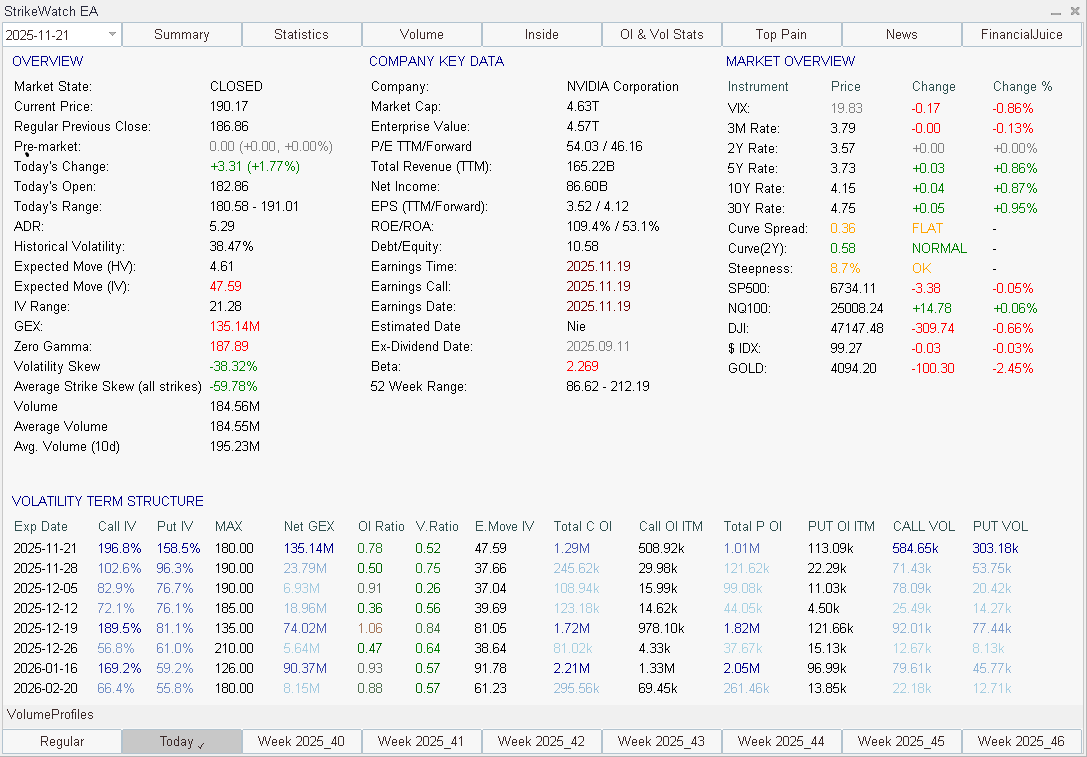
StrikeWatch EA is designed to surface the main expiration-week variables directly on the chart and summary modules so traders do not need to calculate them manually.
- Max Pain module — tracks the key expiration magnet and updates as positioning changes. For the full statistical methodology behind Max Pain, see the dedicated Max Pain Theory article.
- GEX profile — shows where gamma concentration is building and where dealer hedging will either defend or amplify price movement around major strikes. The Strike Wall scoring system is the practical framework for reading this profile into actionable structural levels.
- Zero Gamma Level overlay — confirms the current gamma regime (positive or negative) and its proximity to current price, determining whether expiration week dynamics are stabilizing or amplifying. Full regime mechanics in Dealer Hedging Regimes: GEX and ZGL.
- OI/Volume Statistics module — displays per-strike open interest and volume for the top 15 most active strikes across expirations, providing the raw data for strike wall scoring and tracking OI buildup patterns through the OPEX cycle.
- On-Chart HUD — overlays the GEX histogram, ZGL line, and Max Pain level directly on the MT5 price chart, making the complete OPEX structural map visible without switching between tools during a live session.
- Summary Surface — multi-expiration view — displays GEX structure, Max Pain, and IVR context for up to 10 expirations simultaneously, enabling traders to see which upcoming expiration carries the heaviest concentration of structural gamma before the current OPEX cycle concludes.
OPEX is a structural event, not just a date. Gamma builds into expiration
and disappears after it — changing dealer hedging mechanics, price compression, and
volatility behavior on a predictable, repeatable cycle.
Expiration composition matters. Call-weighted OPEX → post-expiration
window of weakness. Put-weighted OPEX → post-expiration stabilization. Know which type
you are trading into.
Gamma accelerates non-linearly. The final 72 hours before expiration
carry 5–10× the gamma sensitivity of the preceding week. Reduce size in the final 3 DTE
and close or roll short near-the-money positions before expiration day.
Pin risk is real and operational. Never hold a short option within $1.00
of spot through the final hour — the after-hours exercise window can produce unexpected
assignment outcomes regardless of where the close prints.
Max Pain becomes actionable only in the 0–3 DTE window. Its full
calculation methodology, DTE relevance table, and Local Pain refinements are in the
dedicated
Max Pain
Theory guide.
Use the Strike Wall scoring framework every session during OPEX week.
The
Strike Wall Analysis guide provides the
complete four-layer scoring system (OI + GEX + PCR + Max Pain) that maps the structural
levels dealers will mechanically defend into any expiration.