Why Margin and Buying Power Matter More Than Your Strategy
Most retail traders obsess over entries, indicators, and strategies. Professionals obsess over margin and buying power. Margin does not only determine how many contracts you can trade — it defines how large an adverse move you can survive before your broker forcibly liquidates you.
In options trading, this is amplified. Short premium positions can lose value nonlinearly, and margin requirements can jump when implied volatility spikes. A position that looked “small” on Friday can suddenly consume your entire buying power on Monday after a gap move. Understanding how Reg-T and portfolio margin engines work, and then sizing trades around structural supports such as volume floors and positive gamma regimes, is the difference between a temporary drawdown and a terminal blow-up.
This article covers the structural sizing layer of options risk management: the margin engine mechanics, GEX-conditioned buying-power rules, and volume-floor alignment that determine how much of your allowed risk budget to deploy at any given time. For the full four-layer framework that integrates structural sizing with dollar-risk rules, Greek budgets, and tail protection, see Options Portfolio Risk Management Framework. For the dollar-risk layer specifically — the 1–2% per-trade rule, monthly loss limits, and drawdown circuit breaker — see Options Risk Management and Position Sizing Guide.
Core Margin Concepts: Equity, Margin, and Buying Power
Before diving into Reg-T vs portfolio margin, it is essential to define a few core quantities that every broker’s risk engine tracks:
- Net liquidation value (NLV): The mark-to-market value of your account if all positions were closed immediately — cash plus or minus open P&L.
- Initial margin: The capital required to open a position. For marginable stocks under Reg-T this is typically 50% of the purchase price; for options it is calculated from OCC/FINRA formulas or risk-based arrays.
- Maintenance margin: The minimum equity that must be maintained to keep a position open. Falling below this threshold triggers a margin call or automatic liquidation.
- Buying power: The additional exposure you can add before violating margin constraints. In practice, this is your NLV minus required margin, multiplied by whatever leverage the regime allows.
In a Reg-T account, these are mostly calculated using fixed percentages per product type. In a portfolio margin account, the required margin is driven by worst-case simulated loss across a range of shocks in price and volatility for the whole portfolio, not for each position in isolation.
Reg-T Margin for Options: Rules-Based and Conservative
Reg-T (Regulation T) is the long-standing U.S. framework that governs how much credit a broker can extend against customer securities. For stocks, the headline rule is simple: you can generally borrow up to 50% of the purchase price for marginable securities, with maintenance requirements often around 25–30% for long stock, slightly higher for short stock.
For options, Reg-T uses formula-based margin that depends on whether you are long or short, and whether your short options are naked or hedged. Long options are paid in full — margin equals the premium. Short options require significantly more:
| Position Type | Reg-T Margin Logic (Typical) | Risk Profile |
|---|---|---|
| Long calls / puts | Pay 100% of premium. No additional margin. Max loss = premium. | Defined risk, convex payoff, long gamma/vega. |
| Naked short calls | Premium received + max of (20% of underlying − OTM amount, 10% of underlying). | Theoretically unlimited loss, large margin as buffer. |
| Naked short puts | Premium received + max of (20% of underlying − OTM amount, 10% of underlying). | Very large downside tail risk, margin sized accordingly. |
| Vertical spreads | Max loss = strike width × contract size − net credit. | Defined risk; margin approximately equals maximum loss. |
| Covered calls | No additional option margin beyond stock requirement. | Upside capped, downside from long stock. |
The exact formulas vary by broker and regulatory overlay, but the intention is the same: fixed, conservative buffers sized to withstand typical daily moves and moderate volatility shocks. Because these rules are generic and do not fully net risk across your portfolio, Reg-T buying power is often significantly more restrictive than true economic risk would suggest for diversified, hedged books.
Portfolio Margin: Risk-Based Stress Testing of the Whole Book
Portfolio margin accounts replace fixed Reg-T formulas with a risk-based approach. Instead of saying “short puts always require 20% of underlying”, the risk engine asks: “What is the worst one-day loss this entire portfolio could reasonably experience under a set of standardized shocks?”
For U.S. equity and index options, this is typically implemented through the OCC’s Theoretical Intermarket Margining System (TIMS) or related models. The process:
- The risk engine defines a price scenario grid for each underlying, e.g. −15% to +15% in ten steps, sometimes larger for high-volatility products.
- For each scenario, it re-prices all options and stock in the account using an options pricing model that incorporates both spot and implied volatility shocks.
- For each scenario, it computes the portfolio P&L; the largest theoretical loss becomes the margin requirement (with regulatory cushions).
Hedged positions and diversification across underlyings can substantially reduce this scenario loss, so portfolio margin frequently allows more leverage for market-neutral, spread-heavy, or cross-hedged books. The trade-off is that mis-specified or concentrated portfolios can be granted very high leverage right up until a regime shift, at which point losses accelerate rapidly. This is precisely why the Greek-budget layer — monitoring aggregate portfolio delta, gamma, and vega against defined limits — exists as a complementary control. Full Greek-level portfolio risk in Portfolio-Level Greeks: Managing Delta, Gamma, Theta and Vega Across Your Book.
Naked vs Defined-Risk Structures: Buying Power Footprint
From the margin engine’s perspective, the key question is simple: What is the maximum plausible loss? Structures with capped loss are cheap to margin; naked convexity is expensive.
| Structure | Max Loss | Reg-T Margin (Typical) | Portfolio Margin Impact |
|---|---|---|---|
| Short naked put | Approx. strike × 100 − premium (if stock → 0). | Large percentage of underlier; scales with price and vol. | Penalized heavily in downside stress scenarios. |
| Short put spread | Strike width × 100 − net credit. | Generally equal to maximum loss. | Scenario loss capped; attractive in risk-based models. |
| Short call spread | Strike width × 100 − net credit. | Again, roughly max loss. | Far smaller requirement than naked calls. |
| Iron condor | Larger of the two wing widths × 100 − net credit. | Margin = width of wider side. | Portfolio margin often lower if wings are OTM and book is diversified. |
| Covered call | Equivalent to long stock downside − premium. | Stock margin rules apply; call adds little. | Scenario loss primarily driven by equity downside. |
This is why professionals almost always prefer defined-risk spreads over naked short options for systematic premium selling: your margin footprint matches your true risk, and violent volatility spikes are less likely to trigger catastrophic margin calls. The full mechanics of how exercise style and settlement method affect margin footprint — including the material difference between SPX (European cash-settled) and SPY (American physical-settled) for short options — are in Options Contract Specifications: American vs. European, Cash vs. Physical Settlement.
GEX, Zero Gamma Level, and Margin Stress
Margin models do not know about GEX or ZGL directly — they simulate price shocks, not dealer gamma. But GEX regimes and the Zero Gamma Level strongly influence how likely large price shocks are to occur, and thus how realistic the risk engine’s stress scenarios feel in practice. For a complete treatment of the mechanics by which GEX determines whether dealer hedging stabilizes or destabilizes the market — including how to read the ZGL on the StrikeWatch chart and what a regime flip looks like in price action — see Dealer Hedging Regimes: GEX and Zero Gamma Level.
- Positive gamma (price above ZGL): Dealer hedging is stabilizing; they buy dips and sell rips. Intraday ranges tend to compress and large outlier moves are less frequent.
- Negative gamma (price below ZGL): Dealer hedging is destabilizing; they sell into weakness and buy into strength, amplifying every move. Gaps and air-pockets are common.
- Near ZGL: Small changes in spot can flip the entire market from stabilizing to destabilizing behavior within a single session.
For margin risk, this means:
- Short-premium and leveraged positions sized for a “normal” day in positive gamma can be dramatically under-sized for negative-gamma days.
- As price approaches ZGL from above, you should assume that the probability of stress-test scenarios actually occurring increases.
- Sizing positions smaller in negative gamma regimes and near ZGL reduces the risk that your book will hit maintenance margin during a liquidity shock.
The GEX regime also directly conditions what your Greek-budget limits should be. A portfolio with the same nominal delta and gamma exposure carries materially different realized risk in positive vs negative GEX. The Greek-budget methodology for applying regime-conditioned limits is in Portfolio-Level Greeks: Managing Delta, Gamma, Theta and Vega Across Your Book.
Volume Floors and Liquidity: Where Margin Calls Hurt the Most
Volume profile analysis complements GEX by identifying volume floors — price zones where a very large amount of stock has recently changed hands. These zones often act as structural support: passive buyers are willing to absorb selling pressure, and sellers who missed their exit the first time tend to reload orders there. The full methodology for reading High-Volume Nodes (HVNs), Low-Volume Nodes (LVNs), the Point of Control, and Liquidity Density classification is in Volume Profile, Auction Market Theory and Liquidity Density.
Liquidation below a major volume floor is particularly painful:
- Above the floor, liquidity is deep and impact costs are low — market orders can exit without moving price too far.
- Below the floor, the volume profile often shows thin liquidity gulfs. Once price falls through, there may be few resting bids until the next lower node, so forced selling can cascade.
Open interest concentration adds a complementary dimension to volume floors. Strikes with large open interest create structural anchors in the options market that often align with high-volume price nodes in the underlying. When an OI-heavy strike corresponds to a volume floor, the combined structural support is meaningfully stronger than either signal alone. The interaction between OI concentration and dealer hedging flows is in Open Interest vs. Volume in Options: What They Mean and How to Use Both.
For margin risk, the practical rule is straightforward: size positions such that even a break-test of the nearest volume floor does not violate maintenance margin. If your margin tolerance requires forced exits precisely where liquidity is thinnest, the realized loss will be far worse than the model suggests.
A Practical Framework for Sizing Around Margin, GEX and Volume
Bringing these pieces together, you can build a repeatable sizing framework:
- Define your per-position risk budget: Risk no more than 1–2% of account NLV on the maximum loss of any one defined-risk structure, or on the scenario loss of a naked structure. The full position-sizing formula, worked examples for credit spreads, iron condors, and cash-secured puts, and the monthly loss limit framework are in Options Risk Management and Position Sizing Guide.
- Check margin impact in your account type: Simulate the intended trade and record the incremental margin and resulting buying power cushion (NLV − required margin). Total active buying power usage across all positions should not exceed 50–60% of portfolio value at any time.
- Overlay GEX / ZGL regime: If price is in strong positive gamma and well above ZGL, you may allow a slightly tighter cushion; near or below ZGL you should demand a significantly larger cushion. The regime-conditioned sizing table in Options Portfolio Risk Management Framework (Section 5b) provides specific multipliers for each regime.
- Overlay volume profile: Identify the nearest major volume floor(s). Ensure that a move through those levels does not consume all remaining buying power. If it does, cut size until it does not.
- Stress-test correlations: Avoid stacking multiple short-premium trades on underlyings that are all likely to gap together in the same macro shock. Correlation during market stress is always higher than in calm regimes — five tech spreads behave like one position in a Nasdaq selloff.
The goal is not to eliminate risk, but to ensure that risk is borne on your terms — via planned exits and adjustments, not via broker-forced liquidation. Executing adjustments at volume floors and GEX walls rather than at arbitrary price levels requires order-type discipline. The full toolkit of order types for MT5 and their application to options-driven stop placement is in Options Order Types and Execution Strategy for MT5.
Common Margin Mistakes in Options Trading
Even experienced traders routinely underestimate how margin and buying power interact with volatility. The most frequent errors include:
- Ignoring volatility-driven margin expansion: Maintenance requirements can increase when implied volatility spikes, even if price barely moves. Structures that looked safe on Friday can violate maintenance on Monday purely from a vol shock.
- Over-levering naked short options in calm regimes: Selling too many naked puts or calls during low-vol, positive-gamma regimes, under the assumption that “it’s always like this.”
- Clustering risk around the same underlyings and expirations: Loading multiple short structures on the same ticker and expiry concentrates tail risk and margin stress into a single date.
- Allowing buying power usage to drift up with profits: As P&L increases, traders often unconsciously scale up size in proportion, leaving no buffer for the next drawdown.
- Ignoring liquidity structure: Sizing positions such that a breach of the nearest volume floor would automatically trigger liquidation in the thinnest part of the profile.
- Treating portfolio margin as free leverage: Portfolio margin grants higher leverage for hedged books, but the same netting logic that reduces margin in calm regimes can mask concentration risk that materializes suddenly in a correlated selloff.
Margin and Risk Management in StrikeWatch EA
StrikeWatch EA does not control your broker’s margin engine, but it gives you the structural context you need to make margin-aware sizing decisions:
- Summary Surface (IVR, IVP, IV vs HV, Expected Move): Help you gauge how likely it is that stress-test scenarios will be realized in the current regime. When IVR is elevated and IV > HV, the margin engine’s stress scenarios are closer to realistic than usual. Full IV regime methodology in Implied vs. Historical Volatility: What the Market Is Really Pricing. Expected Move formula and boundary framework in Expected Move in Options: Formula, Strike Selection and GEX Confluence.
- GEX and Zero Gamma Level overlays: Show whether dealer hedging is stabilizing or destabilizing and how close spot is to a potential regime flip. This is the primary structural input for Step 3 of the sizing framework above. Full mechanics in Dealer Hedging Regimes: GEX and Zero Gamma Level.
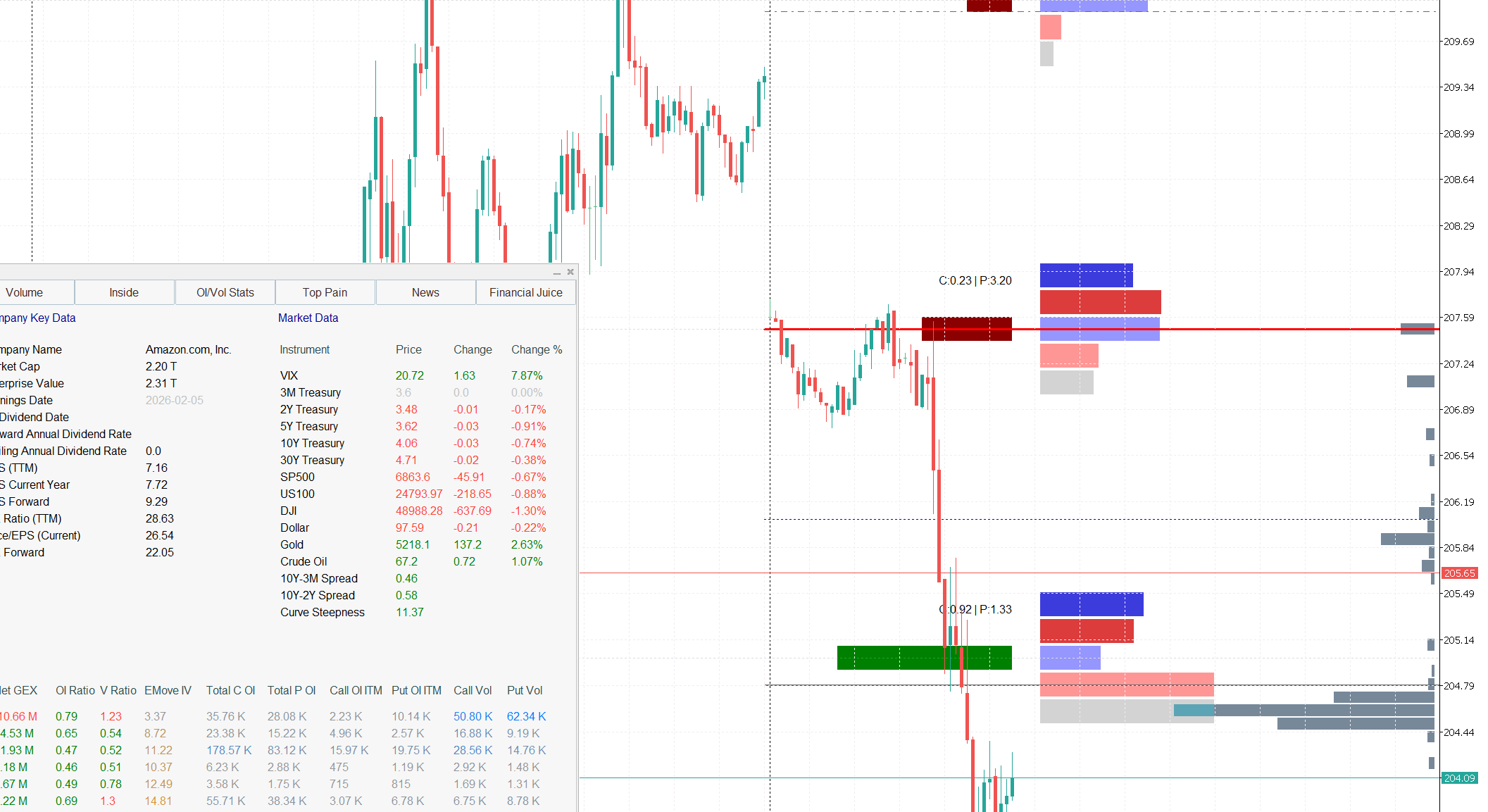
- Volume module and on-chart volume profiles: Identify true volume floors where institutions have accumulated shares, and thin liquidity zones where forced exits will have the worst impact. This is the primary structural input for Step 4 of the sizing framework. Full methodology in Volume Profile, Auction Market Theory and Liquidity Density.
- OI & Flows: Highlights strike clusters where large short-gamma positions may amplify moves, informing how aggressively you should use leverage around those levels. OI interpretation methodology in Open Interest vs. Volume in Options. Institutional flow reading in Options Order Flow & Market Maker Positioning.
By combining these structural insights with a disciplined margin and sizing framework, you turn leverage from a hidden landmine into a consciously managed tool. The strategy may still be wrong; the thesis may still fail. But you dramatically reduce the odds that margin — rather than your analysis — is what ultimately takes you out of the game.
Key Takeaways
- This article covers the structural sizing layer of a four-layer risk management system. For the integrated framework, see Options Portfolio Risk Management Framework.
- Reg-T uses fixed formula-based margin per position type. Portfolio margin uses whole-portfolio stress testing (TIMS), which reduces margin for hedged books but can mask concentration risk. Know which regime your account operates in before sizing.
- Defined-risk spreads consume margin equal to their maximum loss. Naked short options consume multiples of that for the same directional exposure. This asymmetry — not just risk preference — is why professionals default to defined-risk structures for systematic premium selling.
- Never exceed 50–60% buying power utilization across all active positions. The remaining 40–50% is the buffer that allows you to survive adverse moves, meet margin expansion from vol spikes, and add risk when conditions improve.
- GEX regime is a dynamic multiplier on your static limits. In strongly positive GEX you can operate closer to your limits; near or below ZGL you must demand a larger cushion because the probability of the margin model’s stress scenarios actually occurring is materially higher. Full GEX mechanics in Dealer Hedging Regimes: GEX and ZGL.
- Size so that a break-test of the nearest volume floor does not violate maintenance margin. Below volume floors, liquidity gulfs mean forced exits cost far more than models assume. Volume floor methodology in Volume Profile and Auction Market Theory.
- OI concentration and volume floors are complementary structural signals. When a high-OI strike aligns with a high-volume node, the combined structural support is meaningfully stronger than either alone. OI mechanics in Open Interest vs. Volume.
- Dollar-risk rules set the per-trade ceiling. This layer sets the margin-engine constraints. Greek budgets set the sensitivity limits. The correct sizing is the minimum of all three constraints simultaneously. Full Greek-budget layer in Portfolio-Level Greeks: Delta, Gamma, Theta and Vega Across Your Book.