Why Risk Management Trumps Strategy
Consider two traders running the same iron condor strategy with a 65% win rate:
- Trader A risks 2% per trade. After 10 trades (6.5 wins, 3.5 losses on average), the worst-case losing streak of 5 in a row costs 10% of capital. Painful but survivable. The account recovers within 2–3 months of normal trading.
- Trader B risks 15% per trade. The same 5-loss streak costs 75% of capital. The account is effectively destroyed. Even returning to profitable trading, it takes years to recover — and psychologically, most traders never do.
Same strategy. Same market. Same win rate. Dramatically different outcomes. The only difference was position sizing. This is why professional traders obsess over risk management before they ever discuss strategy. A mediocre strategy with excellent risk management outperforms a brilliant strategy with poor risk management — every time, over a sufficient sample.
This article covers the dollar-risk layer of options portfolio management: max loss per trade, monthly loss limits, drawdown circuit breakers, diversification, and capital allocation. For the full four-layer system that integrates dollar risk with Greek budgets, structural sizing, and tail protection into a single daily operating framework, see Options Portfolio Risk Management Framework.
Layer 1: Maximum Loss Per Trade
The first layer of risk management is the most important: how much can you lose on a single trade?
| Risk Level | Max Loss Per Trade | $25,000 Account | $50,000 Account | $100,000 Account |
|---|---|---|---|---|
| Conservative | 1% of portfolio | $250 | $500 | $1,000 |
| Standard | 2% of portfolio | $500 | $1,000 | $2,000 |
| Aggressive | 3% of portfolio | $750 | $1,500 | $3,000 |
| Dangerous | 5%+ of portfolio | $1,250+ | $2,500+ | $5,000+ |
Position Sizing Formula
Number of contracts = Max loss allowed ÷ Max loss per contract
Example 1 — Credit spread: Account: $50,000. Max risk: 2% ($1,000). You are selling a $5-wide bull put spread on SPY for $1.50 credit. Max loss per contract: $5.00 − $1.50 = $3.50 × 100 = $350. Position size: $1,000 ÷ $350 = 2 contracts ($700 max loss < $1,000 limit).
Example 2 — Iron condor: Account: $50,000. Max risk: 2% ($1,000). You are selling a $10-wide iron condor on QQQ for $3.00 credit. Max loss per contract: $10.00 − $3.00 = $7.00 × 100 = $700. Position size: $1,000 ÷ $700 = 1 contract ($700 max loss < $1,000 limit).
Example 3 — Cash-secured put: Account: $50,000. Max risk: 2% ($1,000). You sell a $150 put on AMD for $3.50. Max loss calculation is different: assignment at $150 with $3.50 premium = cost basis $146.50. If AMD drops to $135, your loss is $11.50/share ($1,150). This exceeds your $1,000 limit at 1 contract. Options: (a) choose a lower strike, (b) accept the 2.3% risk, or (c) set a stop-loss at 2× premium collected ($7.00 option price = $350 loss).
Note that the formula above governs dollar risk per trade. How much total buying power you should deploy across all active positions simultaneously — and how GEX and volume structure should modify that allocation — is the structural sizing layer covered in Margin and Buying Power: How to Size Positions Around GEX and Volume Floors.
Layer 2: Maximum Monthly Loss
Individual trade limits prevent any single trade from doing catastrophic damage. But what about a series of losses? The monthly loss limit prevents death by a thousand cuts.
| Risk Level | Max Monthly Loss | $50,000 Account | Action at Limit |
|---|---|---|---|
| Conservative | 3% of portfolio | $1,500 | Stop trading. Review all open positions. Resume next month. |
| Standard | 5% of portfolio | $2,500 | Close all positions. Review strategy and sizing. Resume next month. |
| Aggressive | 8% of portfolio | $4,000 | Full stop. Extended review. May require strategy changes before resuming. |
The monthly limit serves a dual purpose: it caps cumulative damage AND it prevents revenge trading — the destructive pattern of increasing size after losses to “make it back.” When you hit the monthly limit, you stop. No exceptions. The market will be there next month.
Layer 3: Maximum Drawdown
The drawdown limit is the nuclear option — the circuit breaker that prevents account destruction:
- Track your high-water mark (the highest portfolio value achieved).
- Set a maximum drawdown limit: typically 10–15% from peak.
- If the limit is hit: Close all positions. Pause trading for at least 2 weeks. Conduct a full strategy review. Only resume with reduced position sizes (half normal).
Example: Your account peaks at $55,000. Your drawdown limit is 15% ($8,250). If the account drops to $46,750, you stop. This might seem conservative, but consider the math of recovery:
| Drawdown | Recovery Needed | At 2%/Month |
|---|---|---|
| 10% | 11.1% | ~5.5 months |
| 15% | 17.6% | ~8.8 months |
| 25% | 33.3% | ~16.7 months |
| 50% | 100% | ~50 months (4+ years) |
| 75% | 300% | Effectively unrecoverable |
The recovery math is brutal and asymmetric. A 50% loss requires a 100% gain just to break even. This is why limiting drawdowns is not optional — it is existential. For the full recovery protocol including the step-up sizing sequence after a drawdown event, see the dedicated section in Options Portfolio Risk Management Framework.
Trade-Level Stop-Loss Rules
Within the position-sizing framework, each trade needs its own exit rules. Here are the standard approaches for premium sellers:
| Rule | How It Works | Example | Best For |
|---|---|---|---|
| 2× premium stop | Close if the loss reaches 2× premium collected | Collected $1.50 credit. Close if spread reaches $3.00 (= $1.50 loss) | Credit spreads, iron condors |
| 50% profit target | Close when 50% of max profit is captured | Collected $2.00. Close when spread is worth $1.00 | All selling strategies |
| 21 DTE close | Close all positions at 21 DTE regardless of P/L | Opened at 45 DTE. Close at 21 DTE to avoid gamma risk | Iron condors, strangles |
| Delta breach | Close if the short strike delta exceeds a threshold | Sold 0.25 delta put. Close if delta reaches 0.50 | Undefined-risk positions |
| Hard stop on underlying | Close if the stock breaches a technical level | Close the bull put spread if SPY breaks below the 50-day MA | Technical traders who use structure as stops |
The 50/21 Rule
The 50/21 Rule combines the 50% profit target and 21 DTE close into a single management framework. Close the trade at whichever comes first: 50% of maximum profit OR 21 days before expiration. This rule maximizes the favorable early theta decay and avoids the dangerous final weeks when gamma risk accelerates sharply. The mechanics of why the final 21 days carry disproportionate gamma risk — and how the expiration cycle creates structural pinning and volatility effects into OPEX — are covered in Options Expiration Cycle: OPEX, Max Pain and Pin Risk.
Portfolio-Level Diversification
Diversification in options trading is not just about owning different stocks. It requires diversification across multiple dimensions:
- Underlying diversification: No more than 20–25% of portfolio in a single underlying. 3–7 different stocks or ETFs.
- Sector diversification: No more than 40% in a single sector. If you sell premium on AAPL, MSFT, and GOOGL, that is 3 underlyings but 1 sector (tech). A tech correction hits all three simultaneously.
- Strategy diversification: Mix directional (credit spreads) and neutral (iron condors) strategies. When the market trends hard, iron condors lose but directional spreads can win. Strategy diversity smooths the equity curve.
- Expiration diversification: Spread expirations across multiple dates (e.g., some at 30 DTE, others at 45 DTE). This prevents all positions from facing maximum gamma risk on the same day.
- Correlation awareness: AAPL and QQQ are highly correlated. SPY and GLD are lowly correlated. Spreading across uncorrelated assets provides genuine diversification. Spreading across correlated assets provides the illusion of diversification.
40–60% active options positions (diversified across 3–7 underlyings, 2+ sectors, mixed strategies) + 40–60% cash reserve (dry powder for post-correction opportunities when premium is richest). Never be 100% deployed.
Diversification at the position and sector level is the dollar-risk dimension of portfolio construction. The complementary Greek-level dimension — ensuring that your net portfolio delta, gamma, and vega do not accumulate dangerous aggregate exposures even within a well-diversified position set — is covered in Portfolio-Level Greeks: Managing Delta, Gamma, Theta and Vega Across Your Book.
Correlation: The Hidden Portfolio Killer
Correlation is the most underestimated risk in options portfolios. Here is how it works:
You sell bull put spreads on AAPL, MSFT, GOOGL, AMZN, and META. Five different companies, five different spreads. Diversified, right? Wrong. All five are large-cap tech stocks. When the Nasdaq drops 5% in a week, all five positions move against you simultaneously. Your “five positions” behave like one giant position. The 2% risk per trade that seemed conservative is now 10% aggregate risk because all five are correlated.
- Solution 1: Limit sector concentration. Maximum 40% of portfolio in a single sector. If you sell premium on 2 tech stocks, also sell on a financial, a consumer staple, and an ETF.
- Solution 2: Include non-equity assets. Gold (GLD), bonds (TLT), oil (USO) have lower correlation to equities. Selling premium on GLD alongside SPY provides genuine diversification.
- Solution 3: Mix long and short delta. If all positions are bullish (bull put spreads), a market drop hits everything. Adding bear call spreads or iron condors introduces positions that benefit from downward moves, partially offsetting the bullish bias.
Capital Allocation by Strategy
Different strategies require different capital allocation approaches:
| Strategy | Capital Deployed | Recommended Allocation | Why |
|---|---|---|---|
| Covered calls | Full stock value | 20–30% per position | Requires the most capital; limit to 2–3 positions to maintain diversification |
| Cash-secured puts | 100 × strike | 15–25% per position | Similar capital to covered calls; same diversification limits apply |
| Credit spreads | Spread width | 2–5% per position | Low capital requirement; can run 5–10 concurrent positions |
| Iron condors | Single spread width | 3–5% per position | Moderate capital; typically 3–7 concurrent positions |
| PMCC (LEAPS + short call) | LEAPS cost | 10–15% per position | Moderate capital; limit to 3–5 concurrent positions. Full PMCC structure and LEAPS strike selection in LEAPS Options: Long-Term Strategy Guide |
Key principle: The total buying power used across all active positions should not exceed 50–60% of portfolio value. The remaining 40–50% stays in cash. This reserve is not idle capital — it is your survival margin during drawdowns and your opportunity fund for post-correction premium selling when IVR spikes. The full framework for understanding how the margin engine works — Reg-T vs. Portfolio Margin, GEX-conditioned buying-power limits, and volume-floor execution quality — is in Margin and Buying Power: How to Size Positions Around GEX and Volume Floors. The IV timing signal for deploying that cash reserve post-correction is in Implied vs. Historical Volatility: What the Market Is Really Pricing.
Common Risk Management Mistakes
- No pre-defined max loss. Entering a trade without knowing your maximum acceptable loss is gambling, not trading. Define the exit BEFORE the entry — always.
- Sizing up after winners. A winning streak does not change the probabilities. The next trade has the same risk regardless of your last 10 results. Increasing size after wins leads to giving back gains on the inevitable reversion.
- Revenge trading after losses. Doubling position size to “make back” a loss is the fastest path to account destruction. If you hit your monthly loss limit, stop. The market does not owe you a recovery.
- Ignoring correlation. Five bull put spreads on five tech stocks is one position, not five. Correlation during market stress is always higher than during calm markets. Diversify across genuinely uncorrelated assets.
- 100% capital deployment. Having no cash reserve means no ability to take advantage of elevated IV after market corrections (the best premium-selling conditions) and no buffer against unexpected losses.
- Moving stops. When a position hits your pre-defined stop-loss, close it. Moving the stop further away “to give it more room” converts a manageable loss into a catastrophic one.
- Conflating win rate with profitability. An 80% win rate means nothing if the 20% of losses are 4× the size of wins. Expected value = (win rate × avg win) − (loss rate × avg loss). Manage the loss side, not just the win rate.
- Not tracking portfolio Greeks. Individual trades may be well-sized, but the aggregate portfolio delta, theta, and vega can tell a different story. Net portfolio delta of +500 means the entire portfolio moves like 500 shares of stock — potentially a massive unintended directional bet. The methodology for monitoring and correcting Greek drift is in Portfolio-Level Greeks: Managing Delta, Gamma, Theta and Vega Across Your Book.
Risk Assessment in StrikeWatch EA
StrikeWatch EA provides several modules that support risk management decision-making:
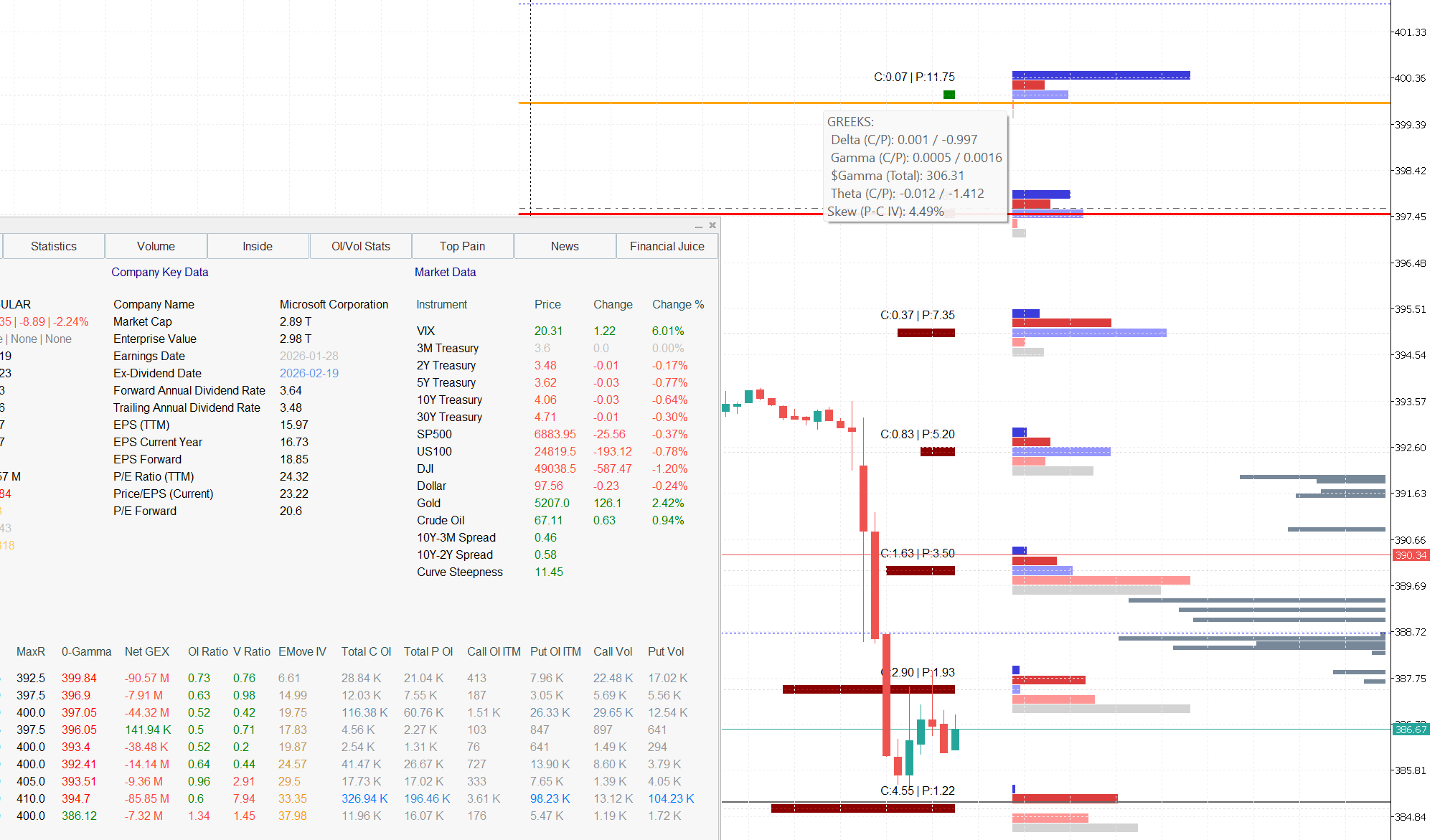
- Expected Move: The 1-SD and 2-SD expected move boundaries show the statistically likely range for the underlying. Positioning short strikes outside the 1-SD range ensures a >84% probability of OTM expiration — the foundation of risk-controlled premium selling. Full Expected Move formula and strike-selection methodology in Expected Move in Options: Formula, Strike Selection and GEX Confluence.
- GEX Profile: Positive GEX zones indicate market maker hedging that dampens price movement. Placing short strikes at positive GEX levels adds structural risk protection beyond statistical probability alone. Understanding why GEX dampens moves in positive regimes and amplifies them in negative regimes is essential for calibrating this module correctly — full mechanics in Dealer Hedging Regimes: GEX and Zero Gamma Level.
- Summary Surface — IV Timing: Selling when IVR > 30 and IV > HV ensures you collect above-average premium for the same risk. This improves the risk/reward ratio of every trade. Selling at low IVR means thin premium that does not adequately compensate for the risk. Full IVR, IVP, and IV–HV spread methodology in Implied vs. Historical Volatility: What the Market Is Really Pricing.
- Max Pain: During expiration week, the Max Pain level shows where options market structure creates the strongest gravitational pull. Positioning iron condors centered around Max Pain aligns your trades with structural forces — a form of structural risk management that complements statistical and sizing-based approaches. Full Max Pain calculation methodology and statistical evidence in Max Pain Theory: How Market Makers Pin Options Strikes at Expiration.
- OI/Volume: Unusual volume spikes at specific strikes can signal institutional positioning that may move the underlying. Identifying these moves before they impact your positions is a risk-management-by-information advantage. Full OI and volume interpretation methodology in Open Interest vs. Volume in Options: What They Mean and How to Use Both.


Key Takeaways
- This article covers the dollar-risk layer of a four-layer risk management system. For the integrated framework connecting all four layers, see Options Portfolio Risk Management Framework.
- The 1–2% max-loss-per-trade rule is the most powerful single tool in options risk management. At 2% risk per trade, 50 consecutive maximum losses are required to lose the account. This is the non-negotiable foundation.
- The monthly loss limit (5–8% of portfolio) is the circuit breaker against death by a thousand cuts. When it is hit, trading stops unconditionally until the next calendar month — no exceptions, no averaging in.
- The drawdown circuit breaker (10–15% peak-to-trough) protects against the asymmetric mathematics of recovery. A 50% drawdown requires a 100% gain to break even. Keeping drawdowns small is a compounding advantage, not a conservative limitation.
- The 50/21 Rule — close at 50% of max profit or 21 DTE, whichever comes first — systematically exits trades before gamma acceleration makes small adverse moves catastrophic. The mechanics of gamma in the final weeks are in Options Expiration Cycle: OPEX, Max Pain and Pin Risk.
- Correlation is the hidden portfolio killer. Five bull put spreads on five tech names is one position in a market selloff, not five. Genuine diversification requires spreading across uncorrelated sectors and asset classes.
- Never exceed 50–60% buying power utilization. The cash reserve is not idle — it is survival margin and opportunity fund. How the margin engine works and how to calibrate deployment to GEX regime is in Margin and Buying Power: GEX and Volume Floor Sizing.
- Dollar-risk rules answer “how much to lose.” Greek budgets answer “how fast can it happen.” The full Greek-level portfolio framework is in Portfolio-Level Greeks: Managing Delta, Gamma, Theta and Vega Across Your Book.