What Are LEAPS?
LEAPS (Long-Term Equity Anticipation Securities) are options contracts with expiration dates that extend one to three years into the future. They are available as both calls and puts on individual stocks, ETFs, and indices. In every other respect — strike prices, contract size (100 shares), exercise style — LEAPS are identical to standard options.
The defining advantage of LEAPS is time. A 2-year LEAPS call on AAPL gives you 500+ trading days for your thesis to play out, compared to 20–30 days for a monthly option. This extra time fundamentally changes the trade’s character: theta decay is minimal for most of the contract’s life, the probability of a favorable outcome is higher, and the trade behaves more like a stock position than a short-term speculation.
LEAPS are typically listed in January expirations. When you see options expiring in January 2028, January 2029, etc., those are LEAPS. As the contract’s remaining life drops below approximately 9 months, it is reclassified as a standard option — but the contract itself does not change.
LEAPS vs Standard Options
| Feature | Standard Options | LEAPS |
|---|---|---|
| Expiration | Days to 9 months | 1 to 3 years |
| Theta decay rate | Fast (accelerates near expiration) | Slow (minimal until final ~6 months) |
| Premium cost | Lower | Higher (more time = more extrinsic value) |
| Vega sensitivity | Moderate (shorter duration = less IV exposure) | High (longer duration = more sensitive to IV changes) |
| Typical use | Short-term trading, earnings plays, hedging | Stock substitution, long-term hedging, income (PMCC) |
| Delta behavior | More responsive to moneyness changes | More stable (deep ITM LEAPS maintain high delta) |
| Capital efficiency | Moderate | High (30–50% of stock cost for similar exposure) |
| Availability | Weekly/Monthly/Quarterly expirations | January expirations (annual cycles) |
The most important difference is theta decay profile. Standard options lose value at an accelerating rate — the final 30 days can destroy 50%+ of remaining extrinsic value. LEAPS, by contrast, experience negligible theta decay for the first 12–18 months. A 2-year LEAPS call might lose only $0.01–$0.03 per day in time value during the first year. This slow decay gives LEAPS holders the luxury of patience that short-term option buyers simply do not have.
LEAPS as a Stock Substitute
The most popular use of LEAPS calls is as a capital-efficient stock substitute. Instead of buying 100 shares, you buy a deep in-the-money LEAPS call that mimics the stock’s price movement at a fraction of the cost. The underlying mechanics — how a long call gains and loses value dollar-by-dollar as price moves — are covered in The Four Option Positions →.
Example: MSFT is trading at $420. Buying 100 shares costs $42,000. A deep ITM LEAPS call with a $350 strike, expiring in January 2028, might cost $85 ($8,500 per contract) with a delta of 0.80. This means:
- Capital deployed: $8,500 (vs $42,000 for shares) — 80% less capital.
- Price response: For every $1 MSFT moves, the LEAPS moves $0.80. If MSFT rises to $470 (+$50), the LEAPS gains approximately $40 = $4,000 per contract. Return on LEAPS: 47%. Return on shares: 12%. The LEAPS provides ~4× leverage.
- Maximum risk: $8,500 (the premium paid). Even if MSFT drops to $300, you can only lose $8,500 — not the $12,000 loss that 100 shares would suffer.
When Stock Substitution Works Best
- Strong conviction on direction: You believe a stock will rise significantly over 1–2 years but want defined risk and leverage.
- Capital constraints: You cannot afford 100 shares of a high-priced stock but want full-size exposure to its movement.
- Portfolio diversification: Using LEAPS frees up capital for other positions. Instead of $42,000 in one stock, you deploy $8,500 in the LEAPS and invest the remaining $33,500 elsewhere.
Strike Selection for Stock Substitution
| Approach | Delta | Strike vs Stock Price | Cost | Tradeoff |
|---|---|---|---|---|
| Deep ITM (recommended) | 0.75–0.85 | 15–25% below current | Higher | Closest to stock behavior; minimal extrinsic value at risk; highest probability |
| ITM | 0.60–0.75 | 5–15% below current | Moderate | Good balance; more leverage but more extrinsic value at risk |
| ATM | ~0.50 | At current price | Lower | Maximum leverage; maximum extrinsic value at risk; needs significant move to profit |
Professional recommendation: For stock substitution, use deep ITM LEAPS with delta 0.75–0.85. The goal is to replicate stock ownership, not to speculate on a massive move. Deep ITM LEAPS have minimal extrinsic value (which you lose to time decay) and maximum intrinsic value (which mirrors stock movement). The higher upfront cost is worth the higher probability of success. For the full framework of how Delta maps to probability and optimal strike zones, see Long Call vs. Short Put: Strike Selection →.
The Poor Man’s Covered Call (PMCC)
The Poor Man’s Covered Call (PMCC) is the most popular LEAPS-based income strategy. It is a diagonal spread that replicates a traditional covered call with 50–80% less capital.
How PMCC Works
- Buy a deep ITM LEAPS call (delta 0.70–0.85, expiring 1–2 years out). This is your “stock substitute” — the long leg that provides directional exposure.
- Sell a short-term OTM call (delta 0.20–0.35, expiring 30–45 days). This is your “income engine” — the short leg that generates recurring premium. The criteria for selling OTM calls (IV regime, optimal DTE, risk profile) are covered in Long Call vs. Short Put → Short Call Section.
- Repeat. When the short call expires worthless (or you buy it back at 50% profit), sell a new short call for the next cycle. You can repeat this 12–20 times over the life of a single LEAPS contract.
Example: AAPL at $185. You buy a $160 LEAPS call expiring in January 2028 for $35 ($3,500). Delta: 0.80. You sell a $195 call expiring in 30 days for $2.50 ($250). If the short call expires worthless, you collect $250 — a 7.1% monthly return on the short call’s risk. Over 12 cycles, that is $3,000 in premium collected — nearly recovering the entire LEAPS cost.
PMCC vs Traditional Covered Call
The traditional covered call requires owning 100 shares outright. The PMCC replaces that share position with a LEAPS call, dramatically reducing capital requirements while preserving the income mechanic:
| Feature | Traditional Covered Call | Poor Man’s Covered Call |
|---|---|---|
| Capital required | Full stock price (e.g., $18,500 for AAPL) | LEAPS cost (e.g., $3,500) — ~80% less |
| Dividend income | Yes — you own shares | No — you hold a LEAPS, not shares |
| Downside risk | Full stock decline (offset by premium) | Limited to LEAPS premium paid |
| ROI on premium collected | Lower (premium ÷ stock cost) | Higher (premium ÷ LEAPS cost) |
| Time decay on long leg | None (stock doesn’t decay) | Yes (LEAPS loses time value slowly) |
| Maximum profit | Short call strike − stock cost + premium | Short call strike − LEAPS strike − net debit |
| Best for | Investors who already own shares | Traders who want covered-call income without full capital commitment |
For recommended PMCC position sizing and portfolio capital allocation (10–15% per position), see the Capital Allocation by Strategy table in Options Risk Management →.
Ensure the short call strike is always above the LEAPS break-even price (LEAPS strike + LEAPS premium paid). If the stock rallies above your short call strike, having the break-even below ensures the position remains profitable. If the short call strike is below break-even, a sharp rally can cause a net loss on the entire structure.
Hedging with LEAPS Puts
LEAPS puts serve as long-term portfolio insurance. Buying a LEAPS put protects against a significant decline in a stock or index over 1–3 years — much longer than standard protective puts.
Example: You hold $100,000 in SPY (S&P 500 ETF) and want protection against a bear market. You buy a $470 SPY LEAPS put expiring in January 2028 for $25 ($2,500). This put gives you the right to sell SPY at $470 for the next 2 years. If SPY drops to $380, your put is worth at least $90 ($9,000) — offsetting most of the portfolio loss. If SPY stays above $470, you lose the $2,500 premium — a 2.5% insurance cost on a $100,000 portfolio over 2 years.
- Advantage over standard puts: A monthly SPY put costs $3–$5 per month. Annually, that is $36–$60 per share — much more expensive than a single LEAPS put at $25 for two years. LEAPS puts are more cost-efficient for long-term hedging.
- Optimal strike for hedging: 5–10% OTM provides a balance between cost and protection. Deep OTM puts are cheaper but only protect against catastrophic declines. ATM puts provide immediate protection but are expensive.
- Collar strategy: Buy a LEAPS put for downside protection, sell a LEAPS call to offset the put’s cost. This creates a zero-cost (or near-zero-cost) collar that defines both maximum upside and downside for the duration.
LEAPS and Time Decay: The Theta Advantage
Theta decay — the daily erosion of an option’s extrinsic value as time passes — follows a non-linear curve that decelerates with increasing time to expiration. The mathematical foundation of this relationship (proportional to 1/√DTE) is explained in Options Greeks Explained →. For LEAPS, this curve creates a uniquely favorable profile:
| Time Remaining | Daily Theta (approx.) | Monthly Cost of Time | Characterization |
|---|---|---|---|
| 24 months | $0.01–$0.02 | $0.30–$0.60 | Negligible — time is your friend |
| 18 months | $0.02–$0.03 | $0.60–$0.90 | Minimal — barely noticeable |
| 12 months | $0.03–$0.05 | $0.90–$1.50 | Moderate — beginning to feel it |
| 6 months | $0.05–$0.10 | $1.50–$3.00 | Accelerating — consider rolling or exiting |
| 3 months | $0.10–$0.20 | $3.00–$6.00 | Fast — standard options territory |
| 1 month | $0.20–$0.50+ | $6.00–$15.00+ | Rapid — exit or roll before this point |
Professional practice: Roll or exit LEAPS positions when they have 6–9 months remaining. After this point, theta decay accelerates into standard-option territory and the LEAPS loses its time advantage. Rolling means selling the current LEAPS and buying a new one with a later expiration — resetting the theta clock.
LEAPS and Implied Volatility: The Vega Factor
LEAPS have significantly higher vega than short-term options. This means their price is more sensitive to changes in implied volatility (IV) — both up and down.
- Buy LEAPS when IV is low (IVR < 30). If IV subsequently rises, the LEAPS gains value from both the stock move AND the IV increase. This is the ideal entry condition — you are buying “cheap” options with room for IV expansion. The full framework for measuring IV Rank and the IV–HV spread is in Implied vs. Historical Volatility →.
- Avoid buying LEAPS when IV is high (IVR > 70). If IV subsequently falls (mean reversion), the LEAPS loses value from IV contraction even if the stock moves in your favor. This “IV crush on LEAPS” is slower than on short-term options but persistent over months.
- The PMCC vega mismatch: In a PMCC, the short call has lower vega than the LEAPS. If IV falls, the LEAPS loses more from IV contraction than the short call gains. This asymmetric vega exposure is a risk unique to diagonal spreads. Manage it by entering when IV is moderate-to-low.
LEAPS Selection Checklist
Use this checklist before entering any LEAPS position:
- Underlying quality: Is this a stock or ETF you believe in for 1–3 years? LEAPS require long-term conviction. Speculative stocks with uncertain futures are poor LEAPS candidates.
- IV environment: Is IVR below 30–40? Low IV = cheap LEAPS. Check the Summary Surface for IVR, IVP, and IV–HV spread before buying.
- Expiration: Choose at least 18–24 months out. This gives maximum time for the thesis to play out and minimizes early theta decay.
- Strike (calls): Deep ITM (delta 0.75–0.85) for stock substitution and PMCC. ATM (delta ~0.50) only for speculative leverage where you accept higher extrinsic value risk.
- Strike (puts): 5–10% OTM for hedging (balance of cost and protection). ATM for maximum protection when you expect significant downside.
- Liquidity: Open interest > 500 at your strike. Bid-ask spread < $0.50. LEAPS can be illiquid on smaller stocks — verify before committing.
- Cost relative to shares: LEAPS should cost 30–50% of the stock price for deep ITM. If a LEAPS costs more than 60% of the stock price, consider just buying shares instead — the capital efficiency advantage diminishes.
- Dividends: If the stock pays significant dividends, factor in the lost dividend income. LEAPS holders do not receive dividends. For high-dividend stocks, the traditional covered call (owning shares) may be more appropriate than the PMCC.
Common LEAPS Mistakes
- Buying ATM or OTM LEAPS for stock substitution. ATM LEAPS have maximum extrinsic value (all of which decays to zero by expiration). For stock substitution, you want minimal extrinsic and maximum intrinsic. Deep ITM is the correct choice.
- Buying LEAPS when IV is elevated. LEAPS have high vega. Buying at high IV means you overpay for time value AND face IV-contraction risk for months. Wait for IV to normalize.
- Holding too long (past 6–9 months remaining). Once a LEAPS enters the 6–9 month zone, theta decay accelerates sharply. Roll to a later expiration before this happens to preserve the time value advantage.
- Ignoring dividends in PMCC analysis. The PMCC does not capture dividends. For stocks with 3–5% dividend yields, this represents significant lost income that must be weighed against the capital efficiency benefit.
- Setting PMCC short call strikes too aggressively. If the short call strike is too close to the current price, you risk being assigned on the short call while the LEAPS has not fully appreciated — creating a loss. Maintain a 0.30–0.50 delta difference between the long LEAPS and the short call to prevent “blowout.”
- Not accounting for early exercise risk on the short call. If the short call in a PMCC goes deep ITM, the buyer may exercise early. You would need to exercise your LEAPS to deliver shares, or buy shares on the open market. Be prepared for this scenario.
LEAPS Analysis in StrikeWatch EA
StrikeWatch EA supports LEAPS analysis through several modules:
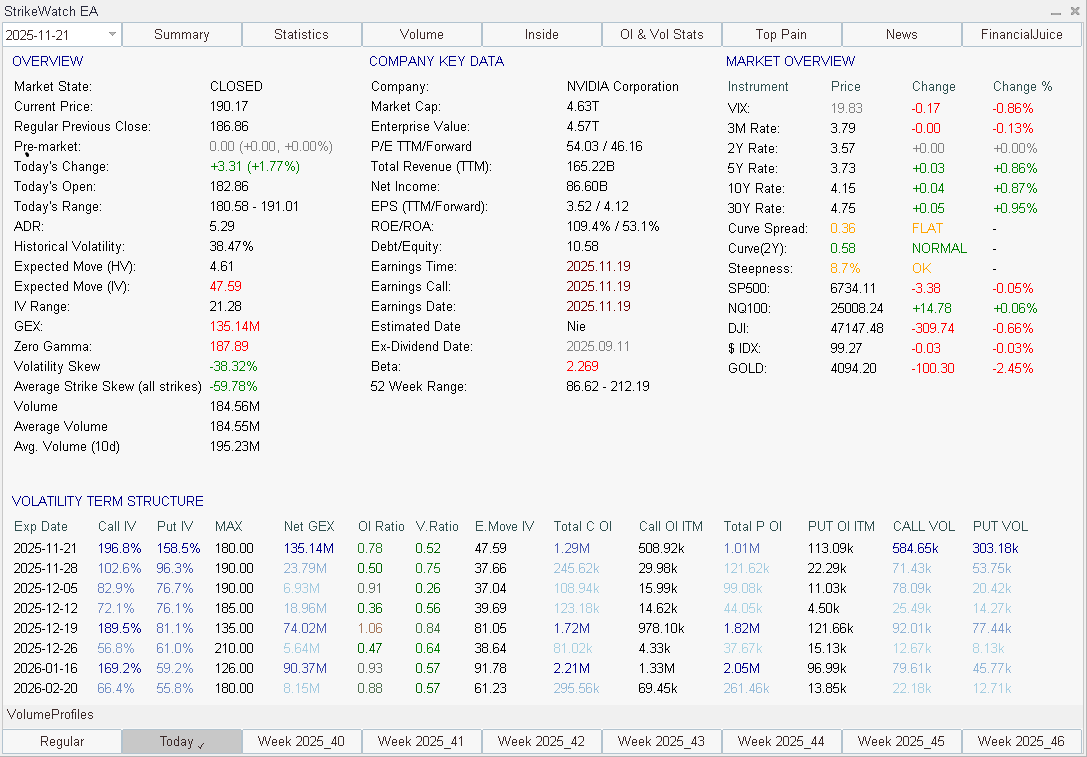
- Summary Surface — IV Rank / IV Percentile: Identifies whether LEAPS are “cheap” or “expensive” by comparing current IV to its 52-week history. IVR < 30 = favorable for buying LEAPS. IVR > 70 = avoid.
- IV vs HV Spread (Summary Surface): Shows whether implied volatility overprices or underprices actual movement. A negative or narrow IV–HV spread means LEAPS are fairly priced; a wide positive spread means they carry a premium above realized movement.
- Expected Move: For PMCC management, the expected move shows the probability range for the short call’s expiration. Setting the short call strike outside the expected move ensures a high probability of OTM expiration.
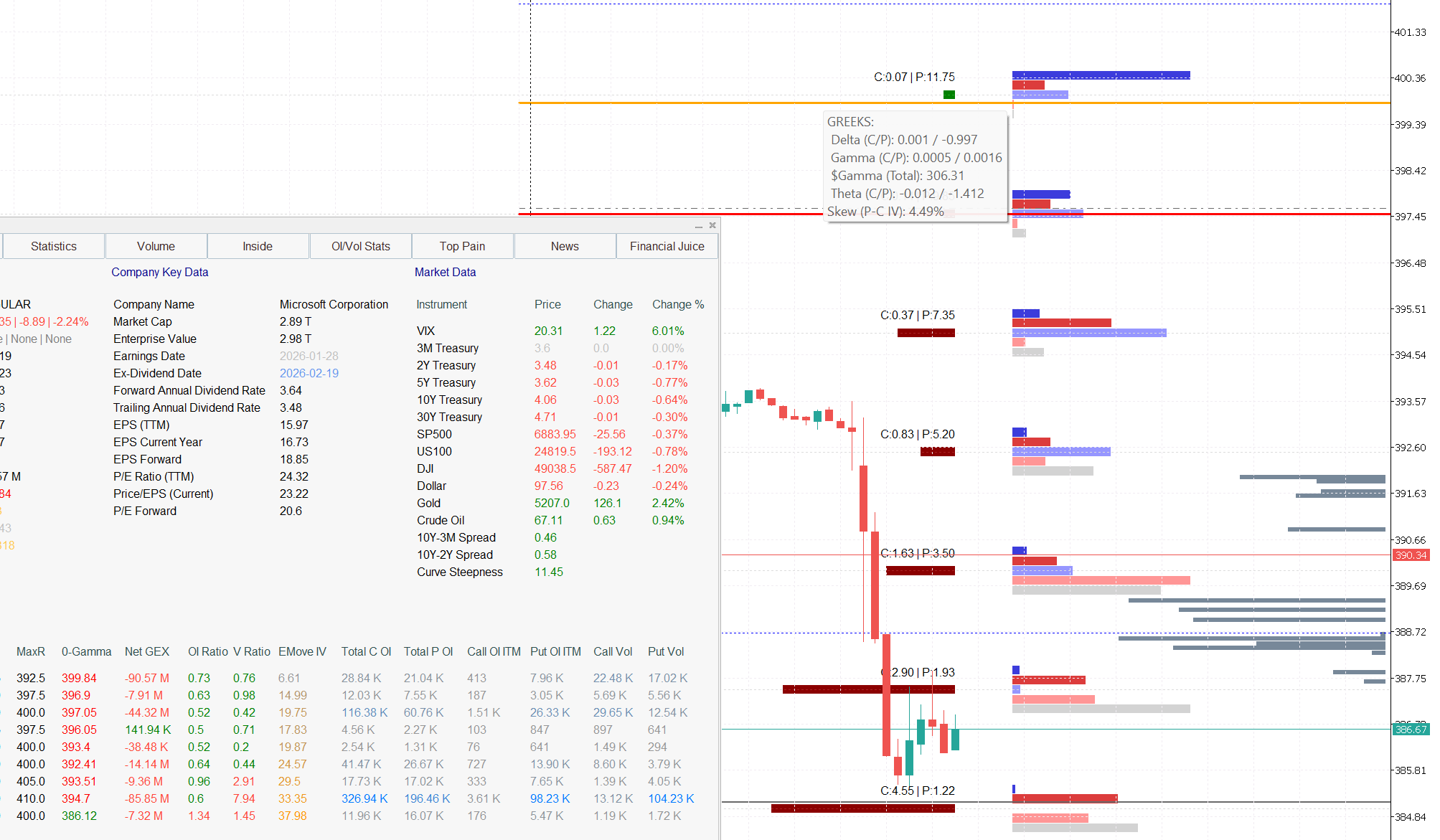
- GEX and Max Pain: For PMCC short call strike selection, GEX positive zones and Max Pain levels indicate structural resistance — ideal strike targets for selling short calls that are likely to be capped by market structure.
LEAPS are long-term options (1–3 years), not a different instrument. They
function identically to standard options but their extended life gives you two structural
advantages: negligible theta decay for the first 12–18 months, and sufficient time for a
long-term thesis to develop without the daily bleed that destroys short-term speculators.
Deep ITM is the only correct strike for stock substitution. Delta 0.75–0.85
minimizes extrinsic value (the portion that decays to zero) while maximizing intrinsic value (which
mirrors stock movement). ATM or OTM LEAPS for stock substitution is one of the most expensive
mistakes in options trading.
The PMCC is the highest-capital-efficiency income strategy in options. It requires
50–80% less capital than a traditional covered call while generating comparable income.
The cost is vega exposure: LEAPS lose more from IV contraction than the short call gains. Enter
when IVR is below 40 to mitigate this asymmetry.
LEAPS puts are the most cost-efficient long-term hedge available. A 2-year LEAPS
put costs less than 12 monthly puts covering the same period. For portfolio protection over bear
market timescales, LEAPS puts deliver substantially better cost-per-day-of-protection than
rolling short-dated puts.
Roll at 6–9 months remaining. After this point, the LEAPS enters
standard-option theta territory and its time advantage evaporates. Selling the existing LEAPS and
buying a new one with a January expiration 18+ months out resets the theta clock and preserves
the position’s structural advantage.
PMCC blowout risk is real. If the short call strike is below your LEAPS
break-even (LEAPS strike + premium paid), a stock rally generates a net loss on the structure.
Always verify the safety rule before selling the short call: short call strike must be above
LEAPS strike + LEAPS premium paid.